

The teaching profession may be a dying one. Fewer people are looking to enter a career as an educator as the pipeline of new teachers is slowing. The reasons are simple to articulate but difficult to resolve. We need to be paying attention.
In Part 1 of our breakdown focusing on why Texas is losing its teacher pipeline, we reviewed how school finance works, how teacher compensation is managed, and why school board leadership matters in influencing the culture and direction that directly impacts teachers.
Today, we’re going to expand this topic to discuss changes in student learning gaps, behavior, and why local leadership makes a huge difference in teacher wellness and retention.
Before we begin, I am going to reshare data from the Texas Education Agency and our previous notes:
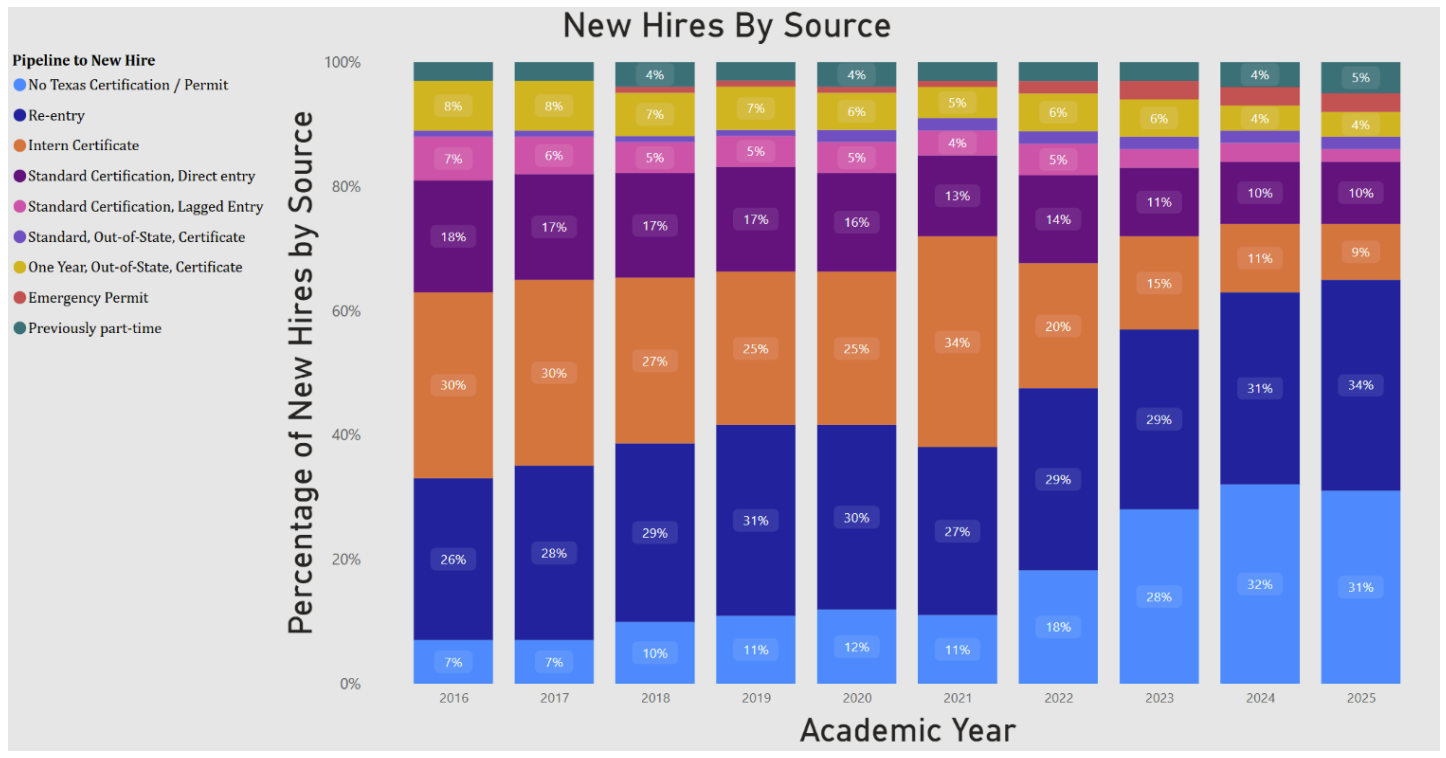
In short, people going into the teaching profession directly have dropped by 41% over the last 10 years, and use of uncertified teachers has risen by 403%.
A large portion of new hires are former teachers coming back to the profession. Districts are aggressively recruiting them as the direct pipeline dries up, and many returnees are motivated by TRS pension incentives, burnout cycles that ran their course, or the realization that the private sector did not offer the opportunities they expected.

What we highlighted was that starting from the basic employment of teachers, such as how they are compensated, Texas has fundamental issues that are both driving teachers away from the profession and preventing others from entering it.
Let’s now talk about the work environment.
Pandemic Learning Gaps
One thing you may hear often from teachers is how much the COVID pandemic impacted student learning, in that there is an obvious gap that spawned from students who were forced to learn from home over Zoom meetings.
In December 2025, the Brookings Institution published research that studied these gaps:
Here is a breakdown of their findings with my comments:
The oldest students took the hardest hit and have the least time to recover. Students who were in middle school when COVID hit are now in high school. The Brookings study tracked foundational math gaps persisting through 8th grade with no sign of closing for older cohorts, and there’s every reason to believe those gaps followed them into high school. Teachers are increasingly being handed a remediation problem with no realistic runway left to fix it.
The gaps are not uniform. A 7th grader in 2025 has different COVID gaps than a 4th grader, and teachers are expected to close both, often with the same resources. There’s no one-size-fits-all fix, which can burn out even the most dedicated teachers.
Math recovery for older students has stalled. The study found that students who were in 4th through 7th grade during COVID still show proficiency gaps of 10 or more percentage points (depending on the cohort) below pre-pandemic levels, and older cohorts have recovered far less ground than younger ones. Teachers are being measured on outcomes they can’t fully control.
Reading recovery has essentially flatlined nationally. Unlike math, which is showing slow improvement in younger grades, English proficiency has shown no meaningful progress since 2022 according to national assessment data. Teachers are dealing with students who are behind in literacy and math simultaneously.
Asking teachers to solve a structural problem without structural support contributes to their reasons for leaving the profession. The research makes clear this is a systemic, multi-year failure that will take systemic intervention to fix. Instead, the burden keeps landing on individual classroom teachers.
This is where decisions on curriculum and adding support structure (e.g., paraprofessionals) in the classroom becomes critical. We need our school boards to be making informed decisions that will work to resolve these issues rather than push untested instructional materials or cutting staff positions where they’re needed most.
Bad Behavior
Anyone who is connected to a teacher knows that the primary struggle with their classrooms is around having to manage bad behavior. Every ‘teacher transition’ trend you find will have teachers lamenting about how they spend a considerable amount of their day managing student behavior. What this means is that time they spend dealing with disruptive students is not spent teaching students.
It’s like a comedian on-stage dealing with constant heckling. They can’t kick out the hecklers without interrupting the bit, and they have to be well-seasoned to manage the interaction so they can continue with their show. This is difficult for both new teachers and veteran educators alike. New teachers have to learn to harden themselves quickly, and veteran teachers have to steel their mental health as constant conflict management can lead to burnout.
When teachers go to school to become an educator, they learn all kinds of things specific to effective instruction, which includes classroom and behavior management. However, classroom management best practices that have worked for decades are not as effective today because of increasing classroom sizes, a decrease of certified professionals (who do not get the same training), and more children seemingly not as responsive to authority.
This is why it has become vital for school districts to consider how it supports teachers through local administrators, behavior interventionists, counselors, and of course, collaboration with parents.
Changes in the relationship between parents and teachers may be the most important issue to understand. Mind you, it is not that support for teachers by parents, PTOs, or other support mechanisms has decreased. The issue is that the number of disruptive children and parents that enable them has increased.
In the past, a teacher may only need to deal with 1-2 disruptive children per class, which could be mitigated by contact with their admin (e.g., principal or assistant principals) or calling home. They could also be managed by a paraprofessional in the room if related to a child with special needs.
Today, that number of disruptive students is now 9-10 children, which has been enabled by the parents who either refuse to discipline their child or actively work against their teacher. If the class includes children with special needs, not having staff support directly impacts their ability to teach the class altogether.
20-30 years ago, if a teacher called home, it was a serious moment for that child. Today, there is a higher chance the parent may ask what the teacher did to make their child act the way they did.
Dr. Brad Johnson, an education consultant, put it well:
“Classroom management hasn’t changed.
The cultural contract around it has.
There used to be a basic understanding in society that adults, teachers included, deserved a baseline level of respect.
Schools operated under the legal principle of in loco parentis.
It literally means “in the place of the parent.”
For generations courts recognized that when students were at school, teachers carried the authority of the parent.
That did not mean blind obedience or unquestioned authority.
But it did mean something simple.
When an adult enforced expectations, the starting point was dignity and respect. They weren’t optional.
In fact, when many of us were in school, we worried far more about getting in trouble when we got home than what might happen at school.
Home and school were aligned.
There was an expectation that adults would support each other in holding boundaries.
That expectation does not seem as clear anymore.
Not all, but some parents now approach schools more like attorneys than partners, questioning every decision instead of reinforcing expectations.
The focus shifts from helping a child grow to challenging the adult who set the boundary.
Students watch that dynamic play out and quickly learn that expectations can be debated.
When that baseline disappears, every expectation becomes a negotiation.
That does not remove adult responsibility.
Some teachers absolutely benefit from stronger classroom management skills. That has always been true.
But that is not the overriding issue.
The larger problem is that classroom management now operates in a culture where limits are routinely challenged, authority is treated with suspicion, and enforcing expectations can carry real personal risk.
Now a teacher can be cursed at, threatened, or even assaulted for taking up a phone.
For enforcing a rule that existed ten years ago.
For doing the job they were hired to do.
That is not a classroom management issue.
That is a cultural failure.
Teachers did not create a culture where enforcing expectations is treated as aggression or where accountability is optional.
But they are expected to manage the fallout.
So when burnout, turnover, and silence are blamed on “better classroom management,” it misses the point.
This is not about skill. It is about risk.
Teachers should not have to fear retaliation for enforcing the very rules they were hired to uphold.
Classroom management was never meant to include worrying about personal safety or public backlash for holding a boundary.
Classroom management did not fail.
The social contract did.”
Simply put, teachers are burdened with problems they were never meant to manage, and the support process from home is breaking down.
That dynamic puts even more weight on local school leadership to either absorb the fallout or make it worse. This brings us to the next important topic.
Local Leadership Matters
When the school district hires principals and assistant principals, it can drastically impact the culture of our schools.
Principals are essentially facility managers. They oversee local operations for a staff that can be from 20-100 people, including managing teacher support, student discipline, and countless other priorities. It is an immense responsibility and is often itself not a well-supported position. They can delegate tasks to assistant principals, secretaries, or front desk staff, but at the end of the day they are responsible for each day of successful instruction at schools that could have thousands of students.
As any corporate worker knows, managers can vary in their style and effectiveness. They have various backgrounds, are often long removed from the positions that they oversee, can make-or-break the cohesiveness of staff, and some may need to retire. Principals are no different.
As an example, if you read our write-up about why Denise left teaching, you’ll see that a significant reason she left was related to local leadership. She worked at the same school for 10 years, two years of which she won Teacher of the Year, and yet it was one of the most challenging environments to work in due to how staff were treated.
The principal was not supportive of teachers’ needs, often making rules and changes that made life more miserable than productive. Teachers would get emotional during meetings as they were publicly reprimanded, and there were more than a few occasions where teachers' spouses wanted to have a word with the principal to discuss the situation.
When a new school in the same grade level opened down the street, nearly half of the staff transferred out. The new school quickly became known as “the happiest place on earth.” Denise followed a few years later, and it was a complete 180 in work satisfaction. The principal was supportive, worked the hallways, and is by far one of the most capable leaders I’ve seen in the school district. They cared deeply for staff, and it showed.
Although her support network immediately improved, the toll of the previous 10 years on Denise's mental health could not be undone. Student behavior was also still a rampant issue, and so she left the teaching profession. She wrote a follow-up on the process one year later.

Local leadership matters, and the culture that these leaders build comes from the top down. From the school board, superintendent, and district support staff - how principals support staff is built through shared understanding and responsibility to make sure educators are given all the resources and care they need to do their jobs well. This directly impacts student outcomes, and it can drastically improve teacher wellness and retention.
Closing
The spotlight on these issues has been shining for years, and none of the ideas presented in this post are new. They simply get overlooked or forgotten, but the experience that teachers have in our schools continues to be a real problem. Our educators may be resilient, and our veteran teachers are able to manage as usual, but these issues within our public schools have impacted the pipeline for new teachers to enter the profession.
Prospective teachers realize that they can work in more supportive environments elsewhere, and they can make a living wage in the process. Our community needs to recognize this and apply pressure to improve these conditions, whether with the school board or the Texas Legislature.
The time to pay attention is now, and the time for action is in the voting booth.
Thanks for reading.