

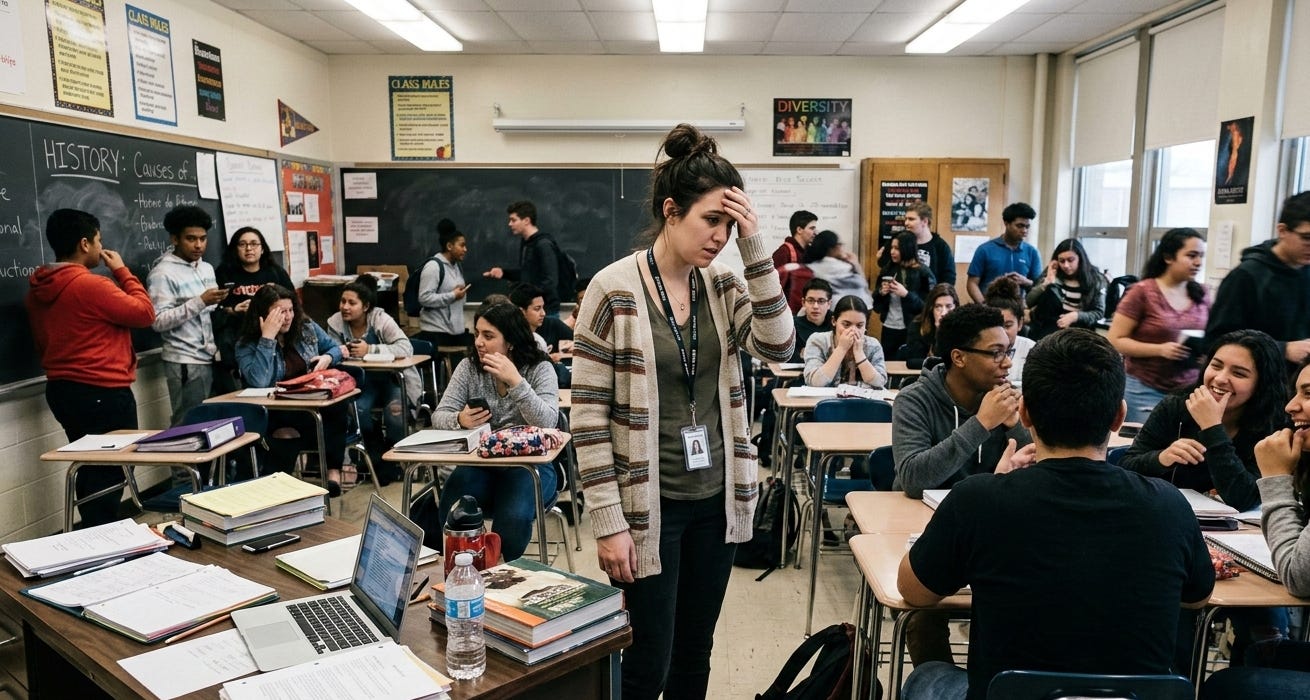
If there is one topic about public schools that seems to unite everyone, it is that of proper student discipline. Although there may be a difference in opinions of how to resolve discipline issues, everyone appears to recognize that there is a problem. Whether it is with bullying, fighting, disrupting classrooms, destroying bathrooms, or wild kids on the bus, we can see that issues are persistent and difficult to resolve year to year.
A common perception is that schools are not doing enough to protect children, and blame often lands upon teachers, administrators, and ultimately school boards.
“Why will the school district not do anything about my child being bullied?!
Why is the child that attacked my student back in class the next day?!
Why is my child being targeted when other children get a free pass?!
This perception can even be different from school to school, as you may have stronger teachers or more experienced administrators able to work through the most difficult challenges.
“My child never had these issues at elementary school, but in middle school they have this other principal, and they do not care about my child.”
Ultimately, we all need to recognize that these little humans are often emotional rollercoasters, and as they grow their personalities can often develop to occasionally surprise us. Sometimes they just make mistakes and need a little direction.
However, when it is your child receiving the negative end of bullying or physical attacks, the issue can quickly become very personal, demanding immediate action by the school.
In this post we are going to break down why discipline is seemingly difficult for our Texas public schools to manage, as well as strategies we could look to for improving them at the district level (where possible).
Before we proceed, let’s first discuss the human factors related to schools disciplining children from the parent’s perspective.
No, not my kid?!
I had a chance to speak with a few school administrators, both former and current. There were a few common themes on this topic.
As it relates to discipline, schools must frequently walk a fine line of being open and fair, while also protecting children that require extra care. As in, all the rules must apply fairly to students based on the code of conduct, but a certain population of students are protected by state and federal law that prevents the school from taking certain actions (e.g., You can’t kick certain children out of school for misbehaving).
Discipline options are restricted by law.
Further, some parents may not believe that their child is the one being disruptive or the bully making another child miserable. Perhaps these parents do not trust teachers or administrators (or the school system itself), or they simply have never seen their child act in disruptive ways. We should also admit that some parents refuse to see fault in their children, perhaps because it reflects negatively upon them as a parent. In rare cases parents may simply not care about their child’s behavior and see it as a problem for the school district to resolve.
Discipline is personal to those impacted, to those being disruptive and those being disrupted in classrooms.
Lastly, when a student is impacted physically or mentally by another student, a parent may feel they are not heard or treated fairly because the school will not divulge to them which punishment the other student is facing. When the other student shows up to school three days later, it reinforces that belief.
Discipline can appear to not be enforced, even though the school is likely following the law and local policy.
As usual, these write-ups are long. If needed, there is a TLDR summary at the bottom if you need to maintain your sanity.
The Education Legal Maze
In researching for this post, I went down several rabbit holes on which federal and state laws are related to student discipline. Here is a quick list, which is most definitely incomplete. Each one has a summary of how they impact student discipline.
Federal
In chronological order
Title VI of the Civil Rights Act - 1964
Prohibited discipline policies that have disparate impact on protected groups
Schools must ensure discipline policies don't discriminate based on race/national origin
Requires documentation showing discipline is administered fairly
Elementary and Secondary Education Act (ESEA) - 1965
Equal access to education through funding school districts with higher percentages of low-income families
Added support through funding professional development
Every Student Succeeds Act (ESSA) - 1965, 2001, 2015
Original federal laws governing K-12 education, reauthorized in 2001 as ‘No Child Left Behind’, then again as ESSA in 2015
Requires states to collect/report school discipline data
Encourages states to support schools in reducing disciplinary removals
Includes provisions about school climate and safety
Title IX of the Education Amendments - 1972
Requires specific procedures for handling sexual harassment/assault allegations
Mandates equal treatment regardless of sex/gender in discipline
Recent updates have changed how schools must handle Title IX investigations and disciplinary proceedings
Section 504 of the Rehabilitation Act - 1973
Protects students with disabilities from discrimination
Requires schools to provide accommodations and evaluate if behavior issues stem from disabilities
Similar protections to IDEA but for students who don't qualify for special education
Family Educational Rights and Privacy Act (FERPA) - 1974
Governs how schools can share disciplinary records
Affects how schools can notify parents/community about incidents
Limits information sharing between schools about student discipline history
Individuals with Disabilities Education Act (IDEA) - 1975
Originally called Education for All Handicapped Children Act
Requires schools to determine if misbehavior is a manifestation of a student's disability
If behavior is disability-related, the school generally cannot remove the student for more than 10 days without providing services
Schools must continue providing education services even if student is removed
Requires positive behavioral interventions before more restrictive discipline
McKinney-Vento Homeless Assistance Act - 1987, 2001
Provides additional protections for homeless students
Schools must consider impact of homelessness on behavior
Requires transportation and educational continuity even during disciplinary periods
Gun-Free Schools Act - 1994
Requires one-year expulsion for students bringing firearms to school
Affects how schools handle weapons-related incidents
Texas State Law
Texas Education Code
Chapter 25: Admission, attendance, and school safety
Chapter 26: Parental rights in discipline
Chapter 37: Student Discipline and School Safety ← The most relevant1
Chapter 38: Health and safety requirements impacting discipline
Texas Penal Code
Chapter 22: Defines assault and related offenses that require mandatory DAEP/expulsion
Chapter 37: Details weapons violations that impact school discipline
Chapter 48: Covers conduct constituting disruption of classes/activities
Texas Family Code
Chapter 51-54: Outlines juvenile justice system interaction with schools
Chapter 65: Covers truancy proceedings and requirements
Sets requirements for parent notification/involvement in discipline
Texas Administrative Code (TAC)
Chapter 89: Special education requirements including discipline
Chapter 103: Safe schools requirements
Chapter 129: Student attendance and truancy standards
Texas Health & Safety Code
Chapter 161: Tobacco/vaping restrictions and discipline
Chapter 481: Drug-free zones and related discipline requirements
Chapter 485: Inhalant abuse provisions affecting schools
Texas Government Code
Chapter 411: School safety requirements
Chapter 772: School safety funding/requirements
At the core of all of these laws, they generally require schools to do the following:
Use student removals as a last resort
Implement progressive discipline approaches first
Maintain educational access even during disciplinary periods
Follow detailed procedures, especially for students with disabilities
Discipline Escalation
Understanding there are many laws around student discipline, let’s now break down the most common steps for how discipline is applied in schools.
We need to note that although schools must follow Texas and federal laws, not every school district utilizes all the tools at their disposal due to lack of support staff, facilities, or other factors that may impact their ability to handle certain behavioral incidents. Some districts may simply not have a great discipline management plan.
Classroom Discipline
Discipline typically begins in the classroom where teachers apply interventions for disruptive behavior. Those familiar with this may understand the Multi-tiered System of Supports (MTSS), which is a “framework that encompasses supports for the whole child, including academics, behavior, mental health and wellness.” There are multiple tiers within the MTSS, which is notable but not important for our discussion here.
Common steps for teachers can include the following when a student is disruptive:
Redirection and verbal warnings
Parent contact (email, phone call, or conference)
Classroom consequences (seat changes, loss of privileges, reteaching expectations)
Teacher documentation of behavior patterns
Behavior contracts or improvement plans
Once these options have been exhausted by the teacher, it then means a discipline referral is typically made. This means the issue moves from the teacher’s domain and to the local campus administration (i.e., Assistant Principals, Principal).
Note that certain types of behavior or incidents go directly to administrators, and in serious situations, law enforcement.
Local Admin Discipline
Through a referral, administrators then have their process, which generally includes the following:
Review the referral and any evidence
Interview the student and witnesses/teacher
(Where applicable) Determine the discipline level (e.g., Level 1-4)2
Apply consequences consistent with the Student Code of Conduct
Notify parents as required
Note that by Texas law, teachers also have the right to request a student be removed from a class under the following options:
Informal removal — student cool-down, brief administrative intervention
Formal removal — triggers a Placement Review Committee if the teacher requests the student not return
Suspension
Based on all of these factors, if the behavior continues, the next step is for In-School Suspension (ISS). This is where a student remains on campus but is isolated from their peers. Their teachers must still provide their coursework for them to complete, parents are sent a notice, and ISS can last indefinitely with review every 10 days (based on latest Texas HB6 2025).
If ISS is not productive and results in repeated misconduct, there is then Out-of-School Suspension (OSS). This is where the student must serve their suspension at a separate location other than the school, and there is a maximum of three days per incident. The teacher still provides the coursework, and OSS can only be enforced if a due process conference is held beforehand with the parent/guardian.
OSS generally means the student is sent home or to a district-designated off-campus location.
Alternative Education Programs
If all else fails, one of the last-ditch efforts to correct behavior is to place a student into a Disciplinary Alternative Education Program (DAEP). There are two types of DAEP placements:
Mandatory — required by law for certain offenses (e.g., drug possession, assault causing bodily injury, terroristic threat)
Permissive — allowed for persistent misbehavior or serious violations not requiring expulsion
DAEP also has several requirements. This includes a formal conference with a notice to parents, a defined length of placement, periodic reviews for long-term assignments, and their original teachers must still send coursework to the student.
The latest Texas law changes allow DAEP to be enforced remotely via virtual school.
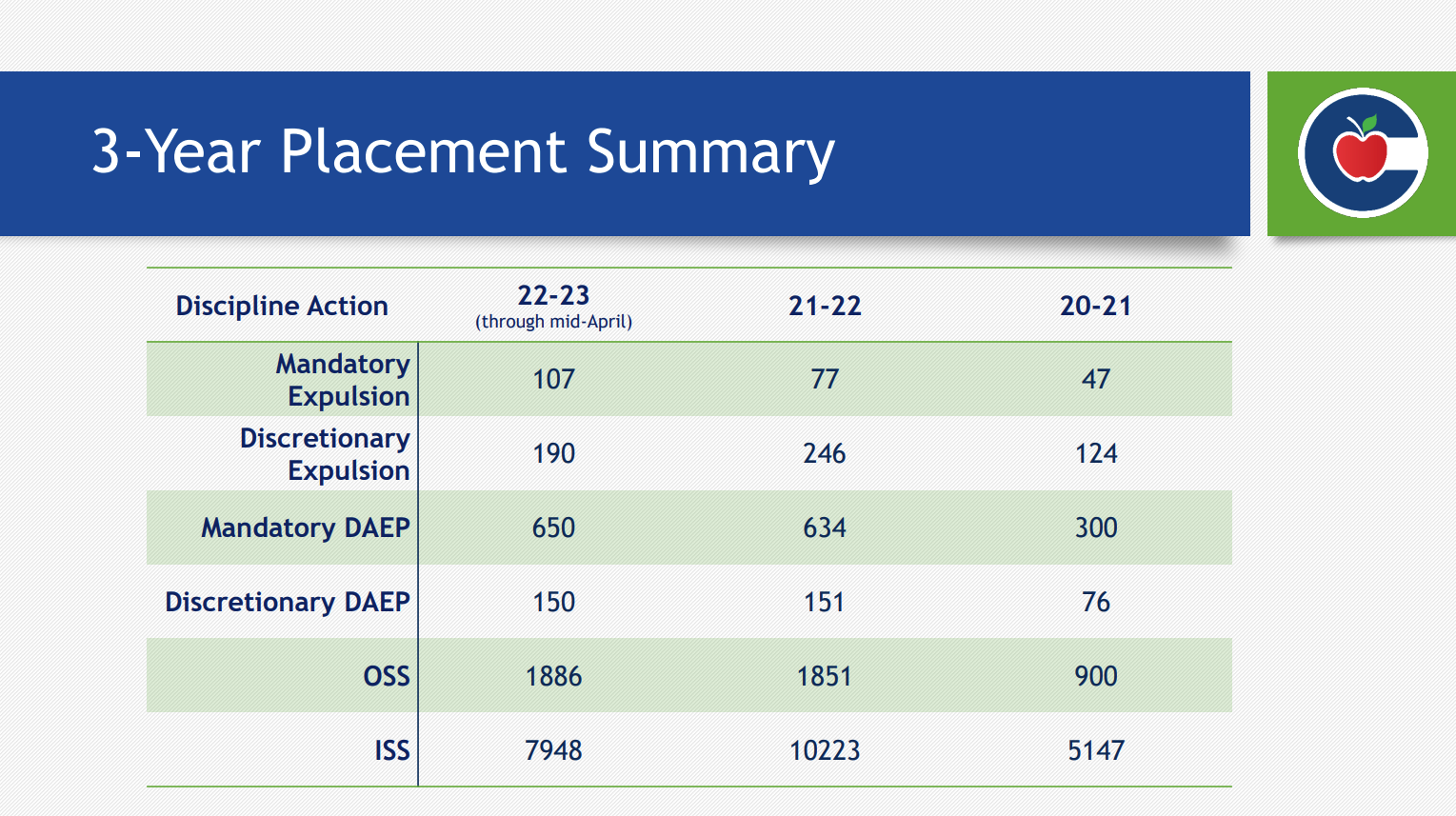
Expulsion and JJAEP
When serious offenses occur, these can require expulsion from the district and assignment to a Juvenile Justice Alternative Education Program (JJAEP). This can include offenses such as possessing a firearm at school, aggravated assault, certain felony offenses, or serious drug or weapons violations.
JJAEP adds a different level of complexity we won’t expand upon here, but it requires the school district to still perform certain administrative actions or meet academic responsibilities for the student, even as they are now under the supervision of the county.
Thoughts on Process
After reading through all the different ways students can face disciplinary actions, we can see how long or difficult these processes can take. Now keep in mind that all of these actions must be well documented by school staff, that they must all follow strict due process aligned with law and local policy, that certain actions have legal thresholds that must be met before serious consequences be delivered, and that none of these are quick or immediate.
Also consider that students with disabilities have further protections. For example, if you have an autistic child in a classroom, and they are continuously disrupting class, there are limited options for staff to use for resolution. This is when having extra staff resources, such as paraprofessionals or behavioral coaches, becomes vital, as they can assist with outbursts or when these students need special care.
Lastly, all of these actions are kept confidential to the student and parents specific to the child being disciplined. For example, if your child is being bullied in school, and the school puts the bullying student through the discipline process, the school is not allowed to give you the information related to their discipline. It may leave you in the dark, but it does not mean the school is not doing what it is required to.
Now that we are familiar with relevant laws and processes, let’s move on to understanding the different methods of discipline.
Punitive vs Alternative Discipline
This is often the most hotly debated topic - is it better to punish children directly (e.g., suspension, corporal punishment, expulsion, etc.) to resolve short-term compliance and act as future deterrent? Or is it better to use alternative methods that includes behavioral intervention, social-emotional learning, trauma-informed approaches, or restorative justice?3 Should it be a mix?
I will start with my own anecdotal experience, growing up in the 90s in a small East Texas town that practiced corporal punishment.
Corporal Punishment
It may seem odd to discuss this in 2026, but I figure everyone should know how it works. Even if you see corporal punishment as child abuse, there are many others, especially in Texas, that see it is a valid form of discipline.
On occasion, I received the bad end of the coach’s paddle at school (there’s no good end either). If you’re not sure what these paddles are, jump on YouTube and search for “Dazed and Confused paddle scene” to get an idea. You don’t forget them.
Essentially, certain discipline levels required corporal punishment that included getting “a lick” or two from the paddle, often distributed by coaches or the Ag teacher.
The truth is that corporal punishment seems to have an interesting history in Texas schools, and as far as I’m aware there are still school districts that practice it today. It still requires permission from parents, and those that sign the form likely do so gladly because of their own upbringing.
Texas is one of 20 states that still allows the practice in general, and school districts that allow corporal punishment by policy are typically found in rural areas. You can find your local school district’s policy by looking for local policy code FO (Student Discipline).4
I can say two things about corporal punishment: It was somewhat effective for me as a young man, but it was also a rite of passage that had us laughing at receiving a paddling more than worrying about it. Sending me to ISS would have been more effective, as I would not have been able to laugh about it with my friends.
Corporal punishment comes with all kinds of legal risks for schools and is generally seen as an archaic form of punishment. Yet there are still those who support it, including certain current school board trustees.
I would never support such an idea in our public schools.
Suspension & Expulsion
The benefit of using suspension or expulsion is that it removes the offending student out of disrupting classrooms. The downside is that the student being disciplined loses instructional time, which they’ll rarely recover, which can lead to lower grades, more struggles to catch-up, social & emotional effects, and a much higher risk of dropout.
Removing students may also not teach replacement behaviors, so when they return from suspension they may return with the same or worse behavior because the root cause was not addressed. We could debate whose responsibility it is to correct these behaviors, the parents versus schools, but let’s skip that for now.
One key item is that suspension and expulsion are documented as part of the student’s record, which can impact future college admission, scholarship eligibility, or even future employment.
However, if school suspension is kept within the school (i.e. ISS), and the student is kept within a structured environment where they can continue learning, then it lowers the negative impacts. This coupled with increased behavioral interventions and counseling can address the underlying social-emotional challenges or help build conflict resolution skills.
This is where success or failure of school discipline policy is directly impacted by the number of professionals available. Having fewer counselors not only impacts mental health support in schools, but also student discipline resolution.
All of this is coupled with engagement of the student’s parents or guardians. Without positive reinforcement from home, changing behaviors at schools becomes very difficult.
Intervention
The other option, as compared to punitive disciplinary actions, is that of intervention. This can include the following:
Behavior Contracts or Agreements – Formal agreements outlining expected behavior with support and accountability.
Example: A student struggling with attendance signs a contract with teachers and counselors to meet weekly goals for class participation, which can be accompanied with rewards.
Counseling or Social-Emotional Support – Individual or group sessions to address underlying issues.
Example: A student with anger management challenges meets with a school counselor weekly.
Peer Mediation / Conflict Resolution Programs – Students are trained to help resolve disputes constructively.
Example: Two students involved in a fight participate in a mediation session guided by trained peer mediators.
Mentoring Programs – Pairing students with adult or peer mentors for guidance and support.
Example: A student with repeated behavioral issues is paired with a teacher or mentor who checks in daily and helps set goals.
In-School Intervention Programs – Structured settings where students remain in school while addressing behavior. This is different than In-School Suspension, which is focused on consequence rather than growth.
Example: Students removed from regular classes attend a support room for reflection, tutoring, and skills-building.
Local Implementation
Our local school district, Conroe ISD, has been discussing student discipline off and on for many years (as do all districts). Many of the public conversations happen in Facebook group posts, but on occasion school boards such as ours discuss discipline and any changes that should be made to policies that impact how discipline is applied to students.
In April 2023, a presentation was given on student discipline within the district; the audio is terrible so turn it up:
You can scroll through the slide deck here: Student Behavior, Student Discipline, and Multi-Tiered Systems of Support
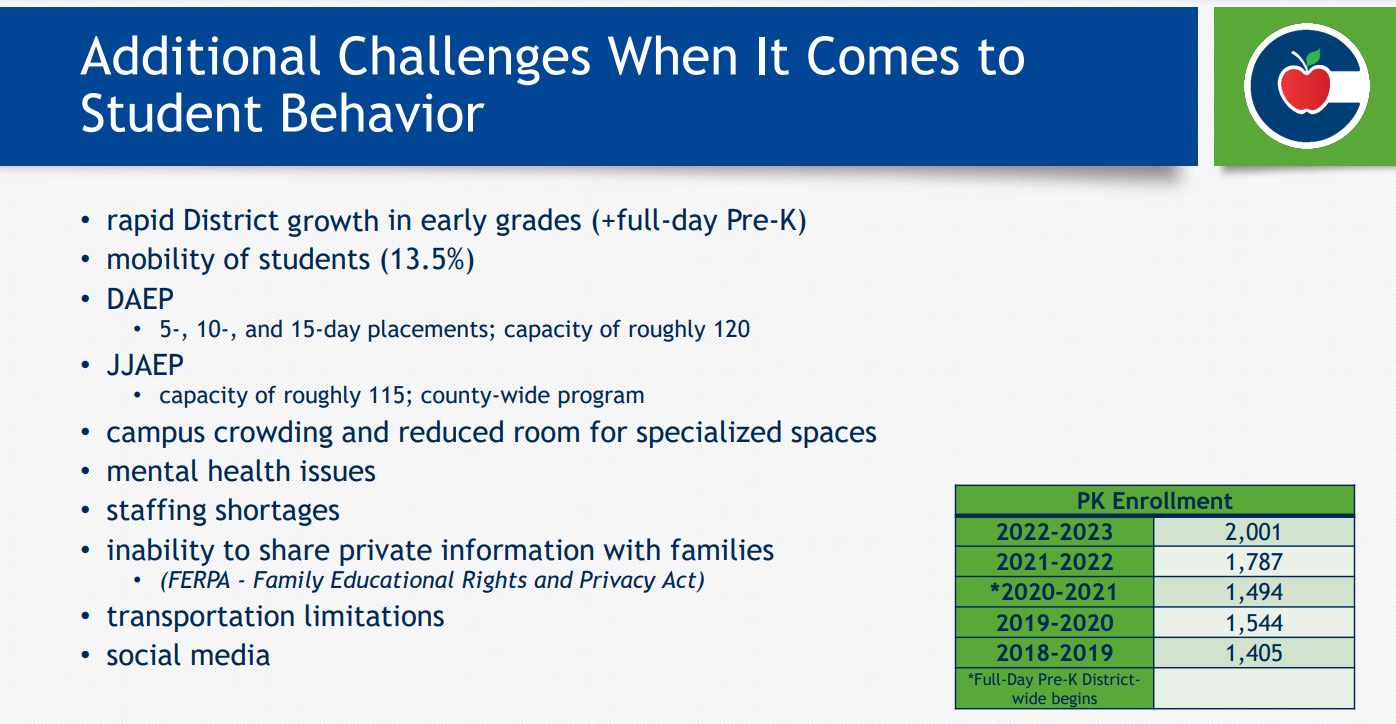
Added to the challenges of discipline, Conroe ISD has also experienced an incredible amount of district growth within a short amount of time. We reviewed this growth during the Community Collaborative meetings, which you can save for later:

This increase in students has forced the district to expand by building new schools, requiring a near $2 billion bond in 2023.5 The number of teachers and resources needed has skyrocketed, during a time when teachers are leaving the profession in droves, partly because of a lack of support in areas like discipline.
This means our schools are at overcapacity while new schools get built, understaffed when teachers continue to call it quits, underfunded as Texas restricts funds we desperately need to pay for teachers and resources, all which can contribute to an increasingly dangerous place for staff and students.
Everything we have reviewed so far barely scratches the surface of how complicated discipline is in practice. Every teacher and administrator can tell you how difficult it can be to correct a child’s behavior, especially when there is limited support at the child’s home or a disincentive to write referrals.
We could spend another 4,000 words on going through how discipline does or does not work depending on the circumstances of the child. Instead, let’s move on to where there may be opportunities to improve.
Opportunities to Improve
With everything we have reviewed so far, how can we improve student discipline to be more effective?
The obvious answer is to get more staff into classrooms and schools. We need more behavioral coaches and related paraprofessionals, more counselors, and more teachers to offload the sizes of classrooms.
That increase in labor obviously requires more funding, which for Texas means more priority from legislature. We are still waiting on comprehensive reforms in this area, unfortunately.
In 2025, the 89th Texas Legislature did pass House Bill 6, which enacted significant changes to school discipline including allowing teachers to remove students for unruly behavior, altering special education disciplinary rules, and prohibiting certain TEA funding penalties for when removing students.
That bill also added funding to expand telehealth service access for schools via the Texas Child Health Access through Telemedicine (TCHATT), allowing schools to provide rapid, free teletherapy and psychiatric services to students with parental consent.
They did not, however, add funding to hire more counselors.
Training & Professional Development
Another common option is to make sure there are enough training or professional developments available for staff to earn Continuing Professional Education (CPE) credits, which can focus on classroom management, intervention strategies, and policy reinforcement.
These are already available to teachers across all school districts, but there is always opportunity to spotlight and prioritize these CPEs by the district administration or school board.
Data Collection
In Conroe ISD, each school has a Foundations team that focuses on data collection, local policies, and student engagement (to name a few tasks). Improving or aligning successful Foundation programs could be driven from a higher level to make sure all schools are working towards good discipline practices that follow the law and policy:
Identify patterns and root causes – Track when, where, and how incidents occur to address environmental triggers like unsupervised areas or schedule pressures
Enable early intervention – Flag students with repeated incidents so schools can implement counseling, mentoring, or behavior plans before problems escalate
Ensure consistency and fairness – Compare disciplinary actions across campuses and staff to confirm similar behaviors receive similar responses
Evaluate what actually works – Measure whether interventions, programs, or policy changes reduce behavioral incidents over time
Guide resource and policy decisions – Use discipline trends to justify staffing needs (counselors, paraprofessionals) and refine district discipline policies
These obviously require staff to commit to data entry in order for the data analysis to occur. We already know staff time is very limited so this type of data collection may be difficult to achieve month to month and year to year. However, this type of data is extremely valuable for the district and school board to review and make decisions for where resources could be focused or advocated for.
Discipline Management Plan
One clear opportunity I see for our school district is to implement a proper Discipline Management Plan (DMP) as part of our Student Code of Conduct.
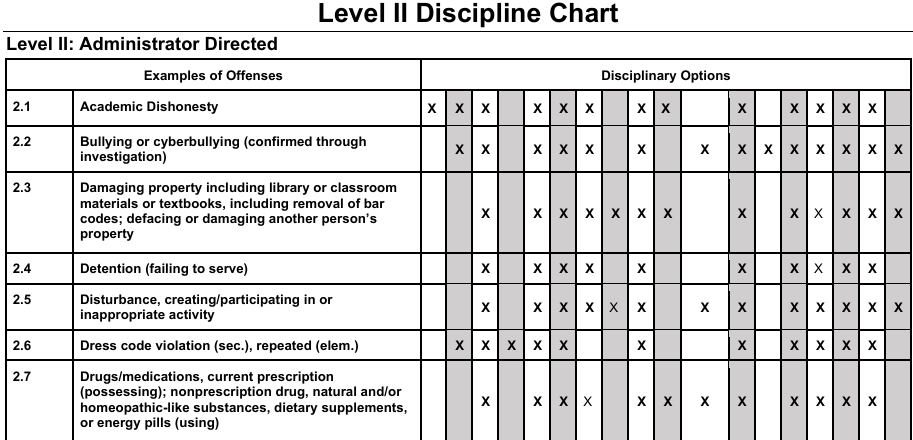
I like how Katy ISD incorporated their DMP as core to their Code of Conduct. They created ‘levels’ with specific discipline actions that occur based on what the student actually did, and they then provide disciplinary options based on those levels. It takes the guesswork out of how severe a particular behavior is and standardizes the consequences.
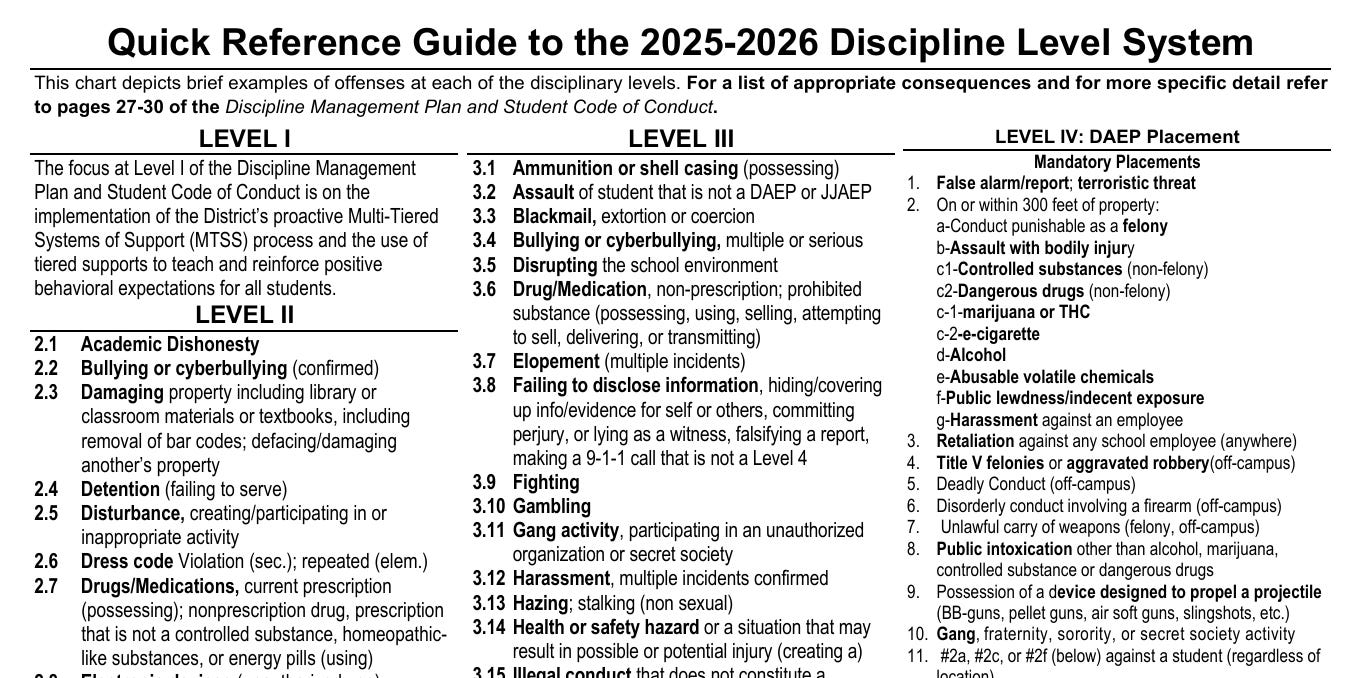
For example, bullying or cyberbullying can be in Level 2 or 3 based on how many times that activity occurred, which then determines the administrator directed options:
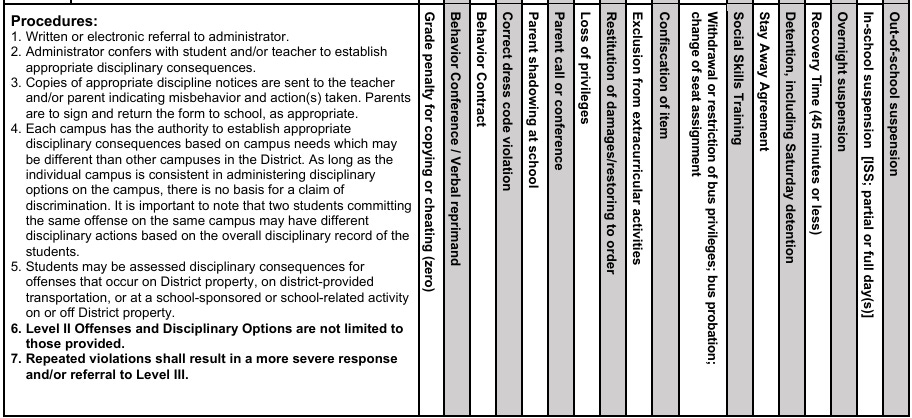
Here are the discipline options turned for easier reading (read from bottom up):
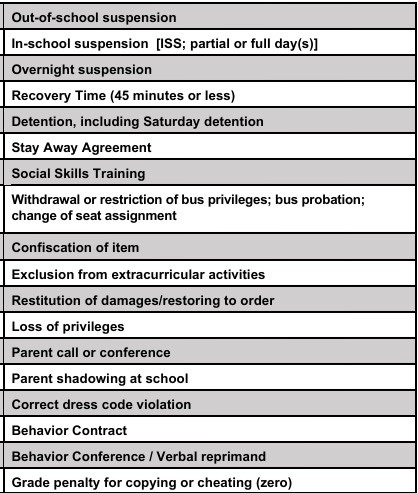
As I am not a school administrator, I cannot give a professional opinion on how well incorporating ‘levels’ into the DMP would work. What I can say is that as a parent I like that actions are defined and organized in a way that gives administrators options for carrying out discipline in schools. It should act more as a guidebook as well as a reference for parents to understand how serious certain behaviors are.
Early Intervention
With data collection and a discipline management plan in place, we can enable faster early intervention to make sure issues are addressed before they escalate. It would improve the already existing workflows such as:
Behavior intervention teams that review repeat discipline referrals and coordinate support
Behavior contracts or improvement plans for students showing early warning signs
Counseling and social-emotional support to address underlying issues like stress, conflict, or trauma
Mentoring or check-in/check-out programs where staff regularly monitor at-risk students
Opportunities Summary
To summarize these opportunities for improvement of student discipline in our school district:
Training and professional development equips teachers with the knowledge they need to do their jobs.
Data collection identifies problems to spotlight where issues are found.
A District Management Plan can set the rules clearly for school staff to follow and parents to understand how discipline is applied.
Early intervention is the mechanism that actually prevents escalation and improves safety.
Closing / TLDR
This was a long deep dive, and it only scratches the surface of how complex student discipline is in public schools. Teachers, administrators, counselors, and other staff have to manage these activities every day, and the students change each year. This means the work is literally never done, which may seem difficult to comprehend for those of us who do not work in schools.
The truth is that maintaining discipline so that students can learn requires a cohesive unit of staff at each campus. School culture is vital to this discussion, even though we did not discuss it here. This culture is built and developed from the top down, which includes both district administration and the school board itself.
AI Summary:
Complex Legal Landscape: School discipline is governed by a dense web of federal laws (like IDEA, FERPA, and Title IX) and state codes that prioritize student rights, privacy, and keeping children in the classroom whenever possible.
The Discipline Process: Misbehavior typically escalates from classroom interventions (redirection, parent contact) to campus administration (ISS, OSS) and, in serious cases, Alternative Education Programs like DAEP or JJAEP.
Challenges in Conroe ISD: Rapid district growth, staffing shortages, and limited state funding create a difficult environment for maintaining consistent discipline while supporting teacher retention.
Punitive vs. Interventionist: While traditional punishments like suspension remove disruptions, they can lead to learning gaps. Modern strategies focus on interventions such as restorative practices, behavior contracts, and mental health support to address root causes.
Pathways to Improvement: Key opportunities for the district include adopting a standardized Discipline Management Plan (similar to Katy ISD’s level system), improving data collection to identify trends, and prioritizing early intervention and professional development.
Thanks for reading.
Progressive discipline is a structured approach used in schools to address student behavior, escalating interventions from warnings to more serious consequences while emphasizing guidance, correction, and improvement.
For example, Katy ISD Discipline Management Plan has a level system that allows for easier identification of where the issue should progress or where to escalate it.
Restorative justice is a philosophy and set of practices that focuses on repairing harm, strengthening relationships, and involving everyone affected by an incident in deciding how to move forward. At its core, it shifts the question from “What rule was broken and how do we punish it?” to “Who was harmed, what do they need, and who is responsible for meeting those needs?”
The irony of the policy being ‘FO’ is not lost on me.
The district actually needed $3 billion, but the 2023 Bond Committee assumed the voters would not accept it, so it was trimmed down considerably.
Ryan, you really do your homework. I appreciate your deep dives! You provide a great resource for information.
As you laid out, managing discipline can become a complex and time consuming part of an already demanding job. It’s just one of the many responsibilities teachers must navigate before they can even get to the core work of teaching curriculum.
In practice, teachers are regularly asked to explain and document the decisions they make throughout the day, and while accountability is appropriate, the sheer volume of these demands adds significantly to their workload. The constant need to pause, justify, and record routine decisions contributes to the burnout that pushes many out of the profession.
More support staff would certainly help, but that level of staffing requires significantly more funding. In the absence of that support, teachers end up absorbing the additional responsibilities, doing the work that would otherwise be shared across a broader team. And on top of that, they still have to manage the full range of other responsibilities that come with the job. There are constant demands pulling their attention in multiple directions, each one requiring time, judgment, and emotional bandwidth.
When the workload keeps expanding without the resources to match it, burnout becomes the predictable outcome. It is no surprise that so many teachers feel stretched thin because the system asks more of them than it is built to sustain.