


One concept I believe your average parent should understand is how your public schools are funded and your child’s teachers are paid. After all, as parents we trust our children to be managed and educated by these professionals 7-8 hours a day, five days a week. We want our children to excel and be prepared to build a life for themselves one day, and teachers are direct contributors to that mission.
Let’s first level with what teachers do. They are more than “lesson guides” or babysitters, as is often portrayed online. They almost all have four-year college degrees; many have a master’s degree or a PhD if they plan to move into leadership positions.
Teachers plan lessons, build and implement curriculum, educate students individually and in groups, build relationships, and accommodate each student’s needs, all while managing a classroom of 25+ kids.
They are also required to know school district policy, classroom management strategies, the Texas Essential Knowledge & Skills (TEKS), mandatory reporting laws, active shooter procedures, and basic first aid. They do all of this while physically at school, with no remote work option, very limited sick days, and the expectation that any absence comes with a substitute plan ready to go.
They can’t even go to the bathroom without making sure someone covers their class.
Teaching can be a rewarding profession, but it can also be a high-stress, low-support environment where your experience is heavily dependent on which students, parents, or administrator you get for the year.
Recognizing this is important. It helps explain both the value teachers bring and the 5-alarm fire we are heading toward as fewer people choose to enter the profession.
These topics deserve more than a soundbite, so this write-up is detailed on purpose. If you’re short on time, skip to the bottom for the TLDR.
Quick Data
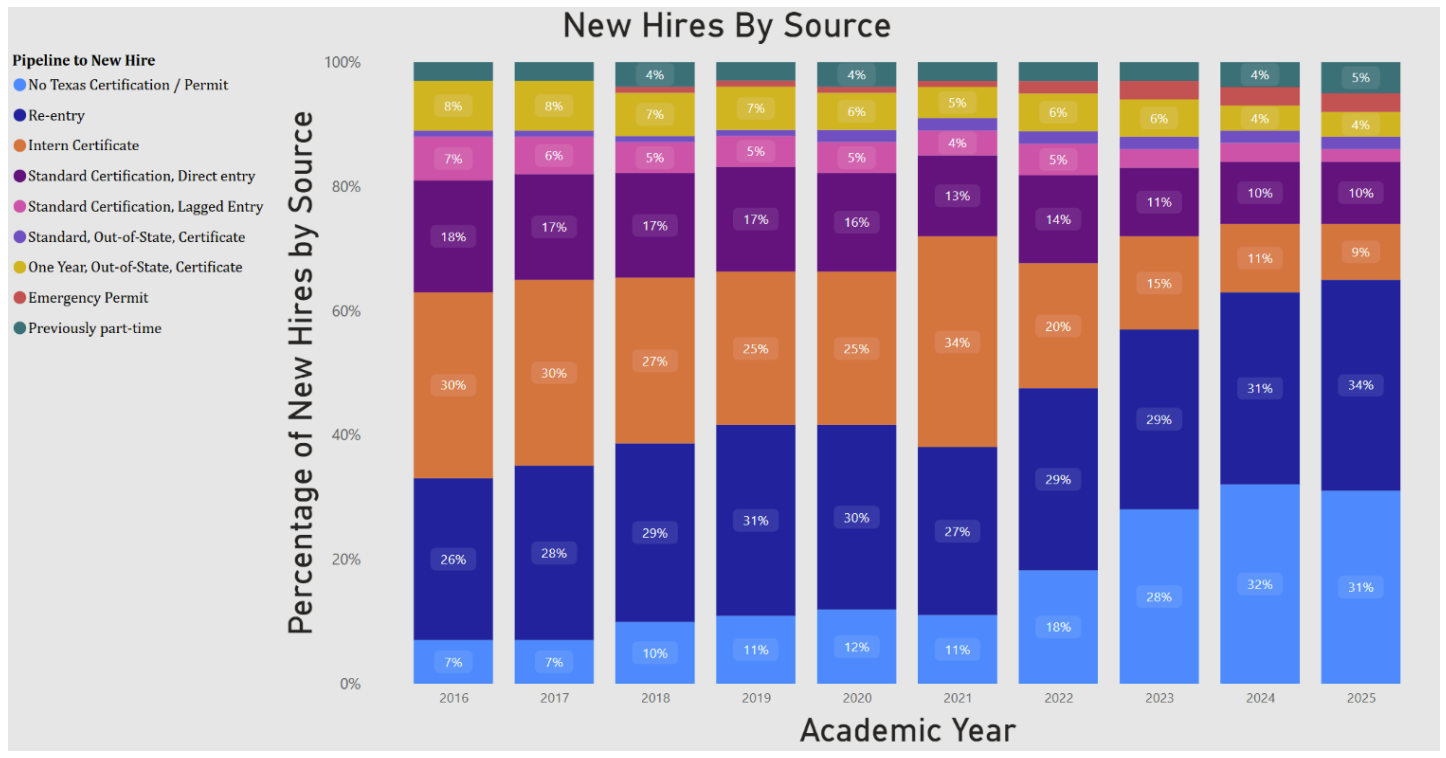
Before we begin, let’s look at the data for teachers entering or leaving the profession as part of the compensation discussion. Looking at the graph above, we see the following trends between 2015-2025:
Fewer teachers are entering the profession directly, showing the pipeline of new teachers is drastically slowing.
Certification gaps are widening, meaning more hires lack formal Texas credentials.
Alternative pathways (interns, emergency permits) are shrinking, possibly due to policy changes or program limitations.
Teacher ‘re-entry’ is a major source of “new” hires, meaning much of our new teachers are actually those coming back to the profession rather than actual new teachers.
Out-of-state hiring is declining, hinting at barriers or reduced mobility.
Here’s the raw data:
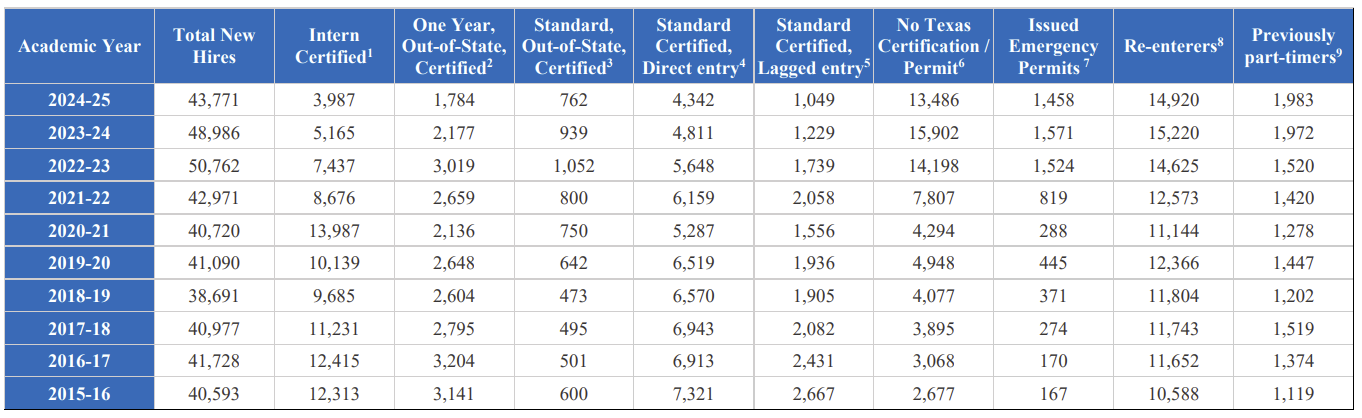
In short, people going into the teaching profession directly have dropped by 41% over the last 10 years, and use of uncertified teachers has risen by 403%.
A large portion of new hires are former teachers coming back to the profession. Districts are aggressively recruiting them as the direct pipeline dries up, and many returnees are motivated by TRS pension incentives, burnout cycles that ran their course, or the realization that the private sector did not offer the opportunities they expected.
For today’s write-up we are going to focus on public school teacher compensation, but obviously there are many, many factors to consider when reviewing topics like teacher retention or the decline in people entering the teaching profession altogether.
Salary Schedule for Teachers
Teachers in Texas are paid based on annual contracts, which renew or can expire yearly, and that contract requires a certain number of work days. For example, for the 2025-2026 school year our local school district requires 187 days of work for teachers. Here is the hiring schedule for 2025-2026:
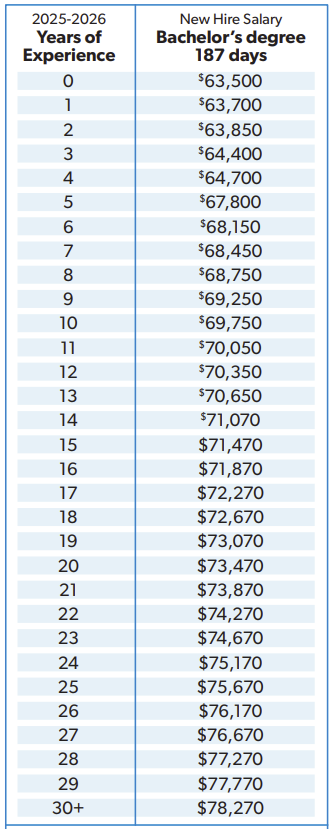
Looking at this, understand that a teacher with 30+ years of experience is only getting paid $15,000 more per year than a brand-new teacher. Can you imagine any other profession where this would be acceptable for someone with a college degree and 30+ years of experience?
Additional Pay
Teachers can earn additional pay based on the following (from the Hiring Schedule referenced):
Master’s or Doctorate Degree: Stipend of +$1,800 per year (either, not both)
Bilingual Certification: +$4,500 per year
Team Leader: About +$1,170 per year
National Board Certification: This enables the teacher to earn extra money we will discuss in a moment. For a teacher to achieve this certification they must spend about $1,900 and 1-3 years depending on certain factors. This cost can be reimbursed or handled up-front by the school district.
These are all pre-tax numbers.
Take-Home Pay
As reference, a teacher with 10 years of experience, a master’s degree, and is a team leader, is making $72,720/year before taxes.
Converting salary to hourly, a teacher making $72,720/year, working 187 days, is making roughly $51.85/hr.1 Taking out federal taxes, retirement, and health insurance, this plummets down to $37.64/hr in take-home pay.2
Again, that’s a best case where the teacher has worked 10 years, has a master’s degree, and is working as a team leader (your high performer).
As a side note, when people debate these numbers, they often compare teachers to other public servants like police officers or firefighters, or with an EMT. The truth is that these conversations incorrectly compare these professions against each other, when in reality it means that they are all very much underpaid.
Neighbor School Districts
If nearby school districts have better or worse salary schedules, then know they operate on similar yet different budgets. Each school district has its own demographics, student populations, assessed value (total value of homes that pay taxes in the district), and priorities.
A school district that is actively growing is issuing bonds, building new schools, expanding existing facilities, and hiring teachers. A district that is in a fully developed area and maintaining status quo likely has less debt to pay and can use those extra funds for higher teacher salaries or have more special education teachers, paraprofessionals to assist in classrooms, or other priorities they can afford.
Some school districts have 2,000 teachers rather than 5,000; this makes discussions around teacher raises very different when you need to find $2M versus $5M just to give each teacher a $1,000/year raise.
This is also why some school districts can afford to give a $15,000 signing bonus whereas others cannot. A school that has a higher population of special education students will have to spend more money for those services as compared to a district with fewer special needs students.
And yes, some districts are within very wealthy areas, while others are in areas with high poverty rates, which directly impact funding sources.
Other Pay Opportunities
Over the last several years there has been a great deal of discussion with the expansion of the Teacher Incentive Allotment (TIA), where teachers can earn six figure salaries.
The TIA is a write-up for another day as it is complex. It is not supported at every school (even within the same school district), is a multi-year process that requires a teacher get evaluated by an appraiser, a ratings distribution system based similar to performance ratings (Recognized, Exemplary, Master), and the appraisal is based on measurable student growth, which is itself complex.
National Board Certified teachers automatically qualify as ‘Recognized’ for their TIA rating.3
It sounds great in theory, but it is a slow-moving process that requires a persistent administration to implement and oversee, and in our school district in 2025, only 384 teachers out of 5,000 have qualified.
The bottom line is that TIA is a real pathway to better pay, but it is not a solution for the broader compensation problem. It reaches too few teachers, too slowly.
Here’s a quick video on how it works:
Who Pays Teachers
Schools pay teachers, but the money comes from a budget that is heavily restricted by the state of Texas. You can read a previous write-up on school finance here.
Here’s the gist of it:
Texas schools are funded through a mix of state dollars and local property taxes.
State funding is tied heavily to Average Daily Attendance (ADA), meaning districts are funded based on how many students attend school each day.
Local funding comes from property taxes, with rates set by the elected school board and paid by local taxpayers based on the value of their property.
These funding mechanisms are combined within general operating budgets for school districts.
For the school district, staff are paid via its Maintenance & Operations (M&O) budget, which covers teacher and staff salaries, benefits, utilities, transportation, and other day-to-day operations. Here’s a breakdown of how each dollar is spent in our local school district:

If a school district wanted to increase pay for teachers, they would be up against several roadblocks. The school district cannot simply raise the tax rates to pay staff more money. This is because Texas implemented a mandatory tax-rate compression system (a.k.a., “SB2”). This means that when property values rise, the state forces districts to lower their M&O tax rate.
Even if the district did raise the tax rate (or not adopt a parity rate), the state has two other mechanisms that reduces its contribution to the school district:
Recapture (“Robin Hood”): If a district raises more local revenue than the state formula says it needs, the state takes the excess.
State funding formulas adjust downward: Even for non‑recapture districts, the Foundation School Program reduces state aid when local revenue increases.

Either way, the district does not get to keep extra money it raises through taxes, which basically forces every school district (and special districts across Texas, like MUDs) to continue lowering their tax rates each year. We could add in the complexity of how rising home valuation has impacted state school funding formulas, but let’s save that for another day.
How do school districts find extra money for teachers?
Each year the school district sets a budget, which is based on all the factors listed above, with the added complexity of understanding how the Average Daily Attendance (ADA) works.4 There are also multiple tiers of funding and other funding allotments available that we will not get into today.
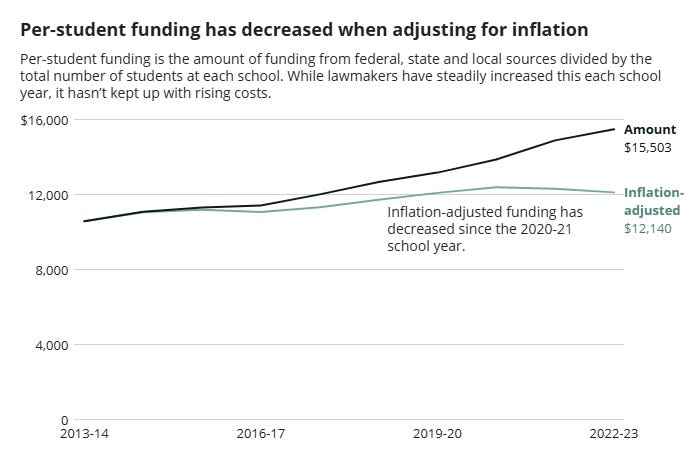
The important factor is that school districts rely almost entirely on the Texas legislature to provide raises for teachers. This is largely based on the per-student funding that the legislature has resisted making major increases to in the last 7 years, which is problematic considering the amount of inflation and high costs of living that have worsened since the 2020 pandemic.
In the last session, the Texas legislature raised the per-student allotment by $55. That’s not a typo. This is compared to when they raised it in 2019 by nearly $1000/student. There are many other factors to consider around total per-student spending, including both state allotments and federal dollars (e.g., ESSER funds), but let’s move on.
One of the only sources available for school districts to increase teacher compensation themselves is to provide retention bonuses or to improve benefits such as healthcare plans.
Where does that extra money primarily come from? Investments.
On occasion Texas will offer retention bonuses to districts through specific allotments, or if the school district is under budget by a significant amount they can turn that around into teacher bonuses. However, the most reliable method to earn extra money is for the school district to make sure it has a healthy reserve fund that is being invested into public fund investment pools.
Those investments have returns.
School districts, like any other good stewards of money, typically keep a healthy reserve fund for emergencies or unexpected costs. Our local school district has a 2025-2026 budget of $760M and a current reserve fund of about $170M. That is slightly over the recommended 20% reserve fund.
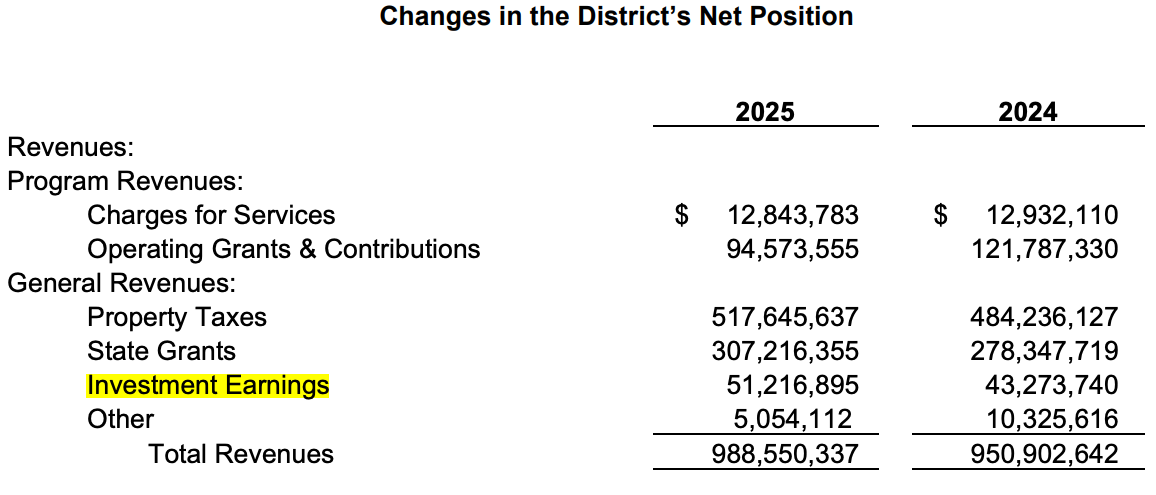
If the reserve fund remains healthy and the budget is on target, then extra money collected can be used for signing bonuses for new teachers or retention bonuses for current teachers or staff.
Program Cuts
Lastly, we should mention that school districts could find other money by cutting services, closing schools, reducing staff, or other creative ways to lower costs.
The truth is that cutting staff is the only real way to save large sums of money, as labor is the largest part of the budget by far.
These are worst case scenarios, and unfortunately these scenarios are playing out all over Texas.
VATREs
I wanted to mention one interesting option, which is a Voter-Approved Tax Rate Election (VATRE). These are a mechanism Texas districts can use to exceed the compressed M&O tax rate cap. It allows money to be added to the budget specifically for things like staff raises.
For example, if the school district needed to increase pay for bus drivers, it could go to the voters directly and ask for help. They put an item on the ballot during a major election, similar to a bond proposition, and they ask voters to approve a small tax increase (max of $0.17 above the compressed rate) that would be specifically used for that purpose.
You could do the same thing for yearly teacher supplies, or yes, teacher raises.
Here’s some quick math on what this could look like. Let’s say the district proposes a VATRE tax increase of $0.02 to M&O budget to raise money for transportation:
Conroe ISD taxable value * tax rate increase = Money generated
$56.5B × ($0.02 ÷ $100) = $11.3M per year
Homeowner impact on a $400K home: ~$52/year or $4.33/month.
This would be politically unpopular in a conservative district like our local Conroe ISD, but it is good to know that these tools are there if needed.
Benefits
Teachers and district staff also need other benefits, such as a retirement fund, health insurance, dental, vision, life insurance, disability insurance, FSA/HSA options, or employee assistance programs.
You could of course include other benefits such as paid conference days, small class sizes, longer summers, or other common options.
These all factor into how competitive a school district is for educators or other district staff.
One key item most people do not know is that most Texas teachers do not pay into Social Security and thus do not pull from it in retirement. In its place is the Teacher Retirement System (TRS), which is a giant can of worms we cannot let loose here.
All of these items factor into total compensation for teachers.
Cost of Living
Numbers on paper only tell part of the story. The other part is what those dollars actually buy you in the Houston area.
Median home prices in the greater Houston area hover around $300,000. With a conventional mortgage at current rates, that’s a monthly payment somewhere around $1,800 to $2,000 after taxes and insurance. Add groceries, utilities, childcare, and a car payment, and a teacher taking home $37.64/hr on a 187-day contract is not living comfortably. They are managing.
It has also been getting worse. Since the last major allotment increase in 2019, inflation has eroded purchasing power by nearly 20%. Teacher salaries did not keep pace. We are asking people with college degrees to do one of the most important jobs in our community and paying them less in real terms than we did a decade ago.
This is not sustainable, and it is a big reason why the pipeline data we looked at earlier should concern every parent in this district.
Closing / TLDR
When someone runs as a candidate for your school board, they will likely talk a big game about supporting teachers (I am one of them). The truth is that there is very little a school board can do to pay teachers more money, BUT they absolutely do have the ability to find money for retention bonuses and improve benefits such as providing resources (e.g., adding paraprofessionals), choosing instructional materials they love, or reducing bureaucratic policies that stifle their ability to do their jobs.
However, the most important thing a school board does is provide leadership that builds a culture of support within the district, and that is honestly the most important benefit that teachers and district staff need today.
If you read this entire thing then consider yourself more informed about how teachers are paid. If you skipped down here, don’t worry, here is a quick summary:
Teachers are skilled professionals with college degrees doing one of the most important jobs in the community, and they are being paid less in real terms than they were a decade ago.
Their contracts are based on working a certain number of days per year, although that contract is not always guaranteed to be renewed the following school year.
Teacher pay is set by a salary schedule. The gap between a brand-new teacher and one with 30+ years of experience is only $15,000 per year.
Teachers with advanced credentials and years of experience are still taking home modest hourly wages after taxes, retirement, and insurance.
The teacher pipeline is drying up. Direct entry into teaching has dropped 41% over 10 years, and use of uncertified teachers has risen 403%.
School districts have almost no independent ability to raise teacher pay. They are boxed in by state tax compression, recapture, and a per-student allotment the legislature raised by just $55 in the last session.
The main levers a district does control are retention bonuses funded through reserves and investments, improved benefits, and the culture leadership creates inside the district.
If you want teachers to be paid more, the pressure needs to go to the Texas Legislature, not just your local school board.
Stay tuned for Part 2 in this series: Why Texas is Losing its Teacher Pipeline
Thanks for reading.
Teachers in Texas are contracted by days, not hours. A standard 187‑day contract does not specify a fixed number of hours per day, but for salary‑to‑hourly comparisons, districts typically use a 7.5‑hour workday as the baseline.
The $51.85/hr figure reflects a teacher’s gross hourly equivalent based on contract days. To estimate take‑home pay, this analysis subtracts typical mandatory deductions for Texas educators: an effective federal income tax rate of ~11%, 1.45% for Medicare (most Texas teachers do not pay into Social Security during their teaching career), and 8.25% for the TRS retirement contribution, totaling 20.7%. This reduces the hourly rate to $41.12/hr. Health‑insurance premiums for Texas teachers commonly range from $300–$450/month; using a midpoint of $400/month, spread across a 1,380‑hour contract year, adds an additional $3.48/hr in costs. After these standard deductions and insurance, the estimated take‑home hourly rate is approximately $37.64/hr.
Under current TEA rules, National Board Certified Teachers automatically receive a Recognized designation through the Teacher Incentive Allotment (TIA). Beginning in the 2026–27 school year, TEA will replace this with a standalone National Board Certified designation, which continues to qualify for TIA funding.
Average Daily Attendance (ADA) is the number of students who actually show up to school each day. Texas funds districts based on ADA, not enrollment, so if a district has 1,000 students enrolled but only 930 attend on an average day, the state funds the district as if it has 930 students. This makes attendance a major driver of school funding and creates significant financial pressure on districts when absences rise.