

If you are going to vote in a school board election, you should probably understand what a school board does. That sounds obvious, but most people show up to the ballot (or skip it entirely) without a clear picture of what board trustees actually control, what they don’t control, and why the distinction matters.
I have served on boards for nearly a decade now, including as President of a Municipal Utility District (MUD) that manages infrastructure and budgets for thousands of residents. I’ve seen firsthand how board governance works at the local level, and I can tell you that the mechanics of a school board are not that different from an HOA board or a MUD board in principle. The stakes, however, are significantly higher. For Conroe ISD, our local district, we are talking about the education of over 70,000 students, a budget of $760+ million, and the employment of 10,000 teachers and staff.
These topics deserve more than a soundbite, so this write-up is detailed on purpose. If you’re short on time, skip to the bottom for the TLDR.
What Is a School Board?
A school board, formally called a Board of Trustees, is the elected governing body of an independent school district (ISD). In Texas, this authority comes from the Texas Education Code (TEC), which gives the board “the exclusive power and duty to govern and oversee the management of the public schools of the district”.1
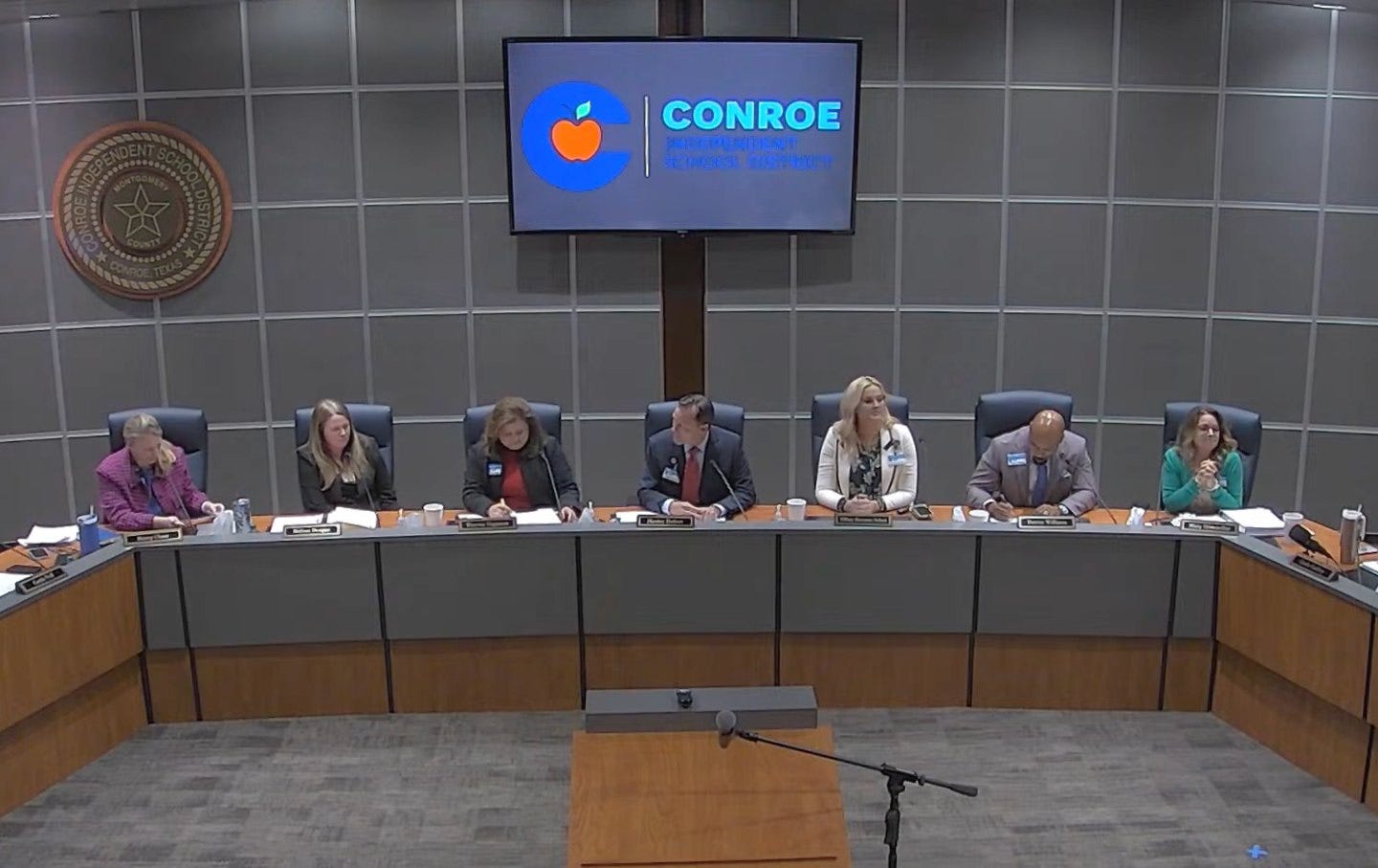
The board is a corporate body, meaning it acts as a single legal entity. No individual trustee has authority on their own. A trustee cannot direct staff, make decisions, or take action independently. The board can only act when a quorum (a majority of members) is present at a properly posted meeting, and decisions are made by vote.
If you have ever been involved with an HOA or a MUD, this concept should feel familiar. The President of your HOA board does not have unilateral power to change the rules. The board must meet, discuss, and vote on pre-planned agenda items. A school board works the same way, just with much bigger consequences.
Structure
Our local school district, Conroe ISD, has seven trustees who are elected at-large by place. This means every voter in the district votes on every seat, but each trustee runs for a specific numbered position (Place 1 through Place 7). Your school district may have less or more trustee positions, and it may elect trustees by region instead of at-large.
Trustees typically serve four-year terms on a staggered schedule. In Conroe ISD, Positions 1, 2, and 3 are elected in one cycle and Positions 4, 5, 6, and 7 are elected two years later.
This staggered approach is common in Texas school districts and is designed to maintain continuity on the board. With this schedule, you rarely have a situation where all seven seats turn over at once.
There are no geographic districts or wards in Conroe ISD. A trustee in Place 1 represents the entire district, not a specific neighborhood or area. This is different from some larger Texas districts that use single-member districts, where each trustee represents a defined geographic area. CISD has historically used the at-large model, but there has been interest lately by constituents to consider single-member districts.
School board trustees in Texas are unpaid volunteers. They receive no salary for this role. This is worth noting because it means your trustees are people who decided to put themselves through the election process and commit significant time to governance without financial compensation. That can attract genuinely passionate people, but it also limits who can realistically afford to serve.
What the Board Actually Does
People often assume school board members are involved in the day-to-day operations of the district. They are not, or at least not meant to be. Under Texas law, the board’s role is governance, not management.
Here’s what a school board’s role looks like in practice:
Hires and evaluates one employee: the Superintendent
This is arguably the single most important thing a school board does. The superintendent is the board’s only direct employee, and the superintendent runs the district. Every other employee, from principals to teachers to custodians, works for the superintendent and the administrative team, not the board. The board sets expectations, evaluates performance, and can choose to renew or not renew the superintendent’s contract.
If you think of it like a company, the board is the Board of Directors and the superintendent is the CEO.
Adopts the vision, goals, and strategic direction of the district
The board sets the long-term vision and monitors progress toward district goals, including academic performance, financial health, and other priorities. This is the most visible and important factor for a school district, as the school district’s primary goal is to improve student outcomes. We touched on this briefly in a previous post:
From AJ Crabill’s Great On Their Behalf:
“School systems exist to improve student outcomes. That is the only reason for which school systems exist. School systems do not exist to have great buildings, have happy parents, have balanced budgets, have satisfied teachers, provide student lunches, provide employment in the county/city, or anything else. Those are all means -- and incredibly important and valuable means at that -- but none of them are the ends; none of those are why we have school systems. They are all inputs, not outcomes. None of those are measures of what students know or are able to do. School systems exist for one reason and one reason only: to improve student outcomes.”
Sets district policy
The board creates policy, and the superintendent implements that policy on a day-to-day basis. Think of policy as the "rules" for how the school district is run and operated. Policies specify things like how purchasing is done, how teachers are evaluated, how student discipline is handled, what the dress code looks like, how complaints are filed, or how the district manages everything from field trips to facility rentals.
Most Texas school districts use the Texas Association of School Boards (TASB) policy framework, which organizes policies into two categories: "legal" policies that reflect what state or federal law requires, and "local" policies where the board exercises its own judgment. The local policies are where the board's priorities and values show up most clearly, because that is where they have discretion. These policies are public and available on the district's website, and if you have never looked at them, it is worth browsing to see just how much of the district's operations are shaped by what the board has approved.
Note that TASB is not the only player in town that provides policy framework. Texans for Excellence in Education (TEE) has been making news over the last few years as an “alternative” service to TASB. They are currently embroiled in a lawsuit with TASB regarding their policy services. You can read more about TEE here.
Adopts the annual budget
The board approves the district’s budget each year. This includes the Maintenance & Operations (M&O) budget that pays for salaries, utilities, and daily operations, as well as the Interest & Sinking (I&S) budget that covers bond debt. As I covered in a previous write-up on teacher compensation, the M&O budget is heavily constrained by state funding formulas, tax compression, and recapture. The board has less flexibility here than most people assume.
Makes personnel decisions on contract employees
The board votes on hiring and termination decisions for employees on TEC Chapter 21 contracts, but the superintendent has sole authority to make those recommendations. The board can accept or reject a recommendation, but it cannot independently select or remove personnel. If the board rejects a recommendation, the superintendent must bring alternatives until the board approves one.
Sets the tax rate
The board adopts the district’s property tax rate each year for both M&O and I&S. However, this is not a blank check. The state’s tax compression system limits how high the M&O rate can go, and voters must approve any rate above the compressed ceiling through a Voter-Approved Tax Rate Election (VATRE). The I&S rate is tied directly to voter-approved bond debt.
Approves bonds and calls elections
When the district needs money for new schools, renovations, or major capital projects, the board places bond propositions on the ballot for voters to decide. The board determines the size and scope of the bond, but voters have the final say.
In larger school districts, bond committees are often formed by the board and filled with appointed public constituents to help build a bond package that is more likely to be supported by voters.
What the Board Does NOT Do
This is where misconceptions live. Understanding what the board cannot or should not do is just as important as knowing what it does.
The board does not manage daily operations. The board does not decide bell schedules, assign students to classrooms, choose which textbook a teacher uses on a given day, or determine staffing at individual campuses. That is the superintendent’s job and the job of the administrative team the superintendent has built.
The board does not hire or fire teachers directly. Teachers are hired and managed by campus and district administrators. The board may see personnel recommendations in the aggregate at meetings, but individual staffing decisions happen below the board level. The exception is contract non-renewals or terminations for Chapter 21 employees, which do come to the board. You may see these as matters posted in executive session during public board meetings.
Individual trustees do not have authority. This is worth repeating. A single trustee cannot direct the superintendent to do something. A single trustee cannot order staff to change a policy or practice. The board acts as a body through formal votes at properly noticed meetings. If a trustee is calling the superintendent to push for changes outside of a board meeting, they are operating outside their authority.
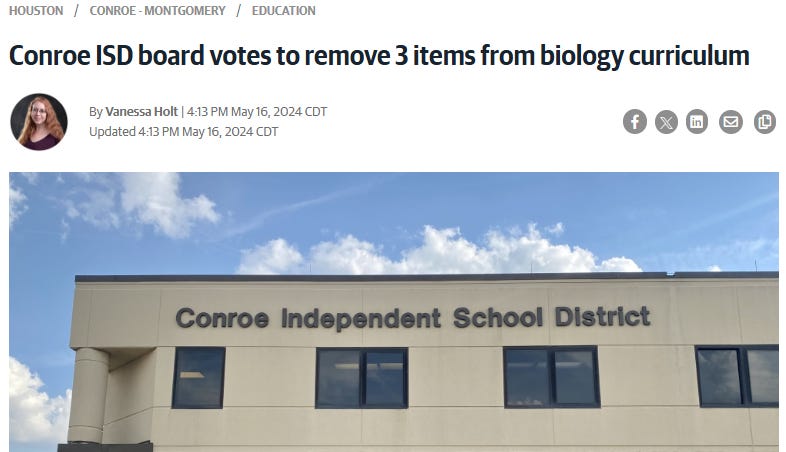
The board does not set curriculum in detail. The state of Texas sets curriculum standards through the Texas Essential Knowledge and Skills (TEKS). The board may adopt instructional materials and approve curriculum frameworks, but the specific content taught in classrooms is driven by state standards and the professional decisions of educators. However, the board can vote to exclude specific content from instructional materials. In May 2024, the Conroe ISD board voted 4-3 to remove sections from a biology textbook, including content on primate evolution and material some trustees considered politically biased, while still requiring the underlying state standards to be taught.
Board Meetings
School board meetings are governed by the Texas Open Meetings Act (TOMA), found in Chapter 551 of the Texas Government Code. This law requires that all meetings of the board be open to the public, with limited exceptions for closed (executive) sessions.
Here is how this works in practice:
Notice requirements: The district must post a meeting notice and agenda at least 72 hours before a regular or special meeting. The agenda must list the specific topics to be discussed. If something is not on the agenda, the board cannot take action on it. This is the law and an important one.
Public comment: Most school board meetings include a period for public comment, where community members can address the board. The board typically listens but does not engage in back-and-forth discussion during public comment. This is standard practice, not a sign of disrespect, as the board does not typically have the time or context to engage every public commenter.
Executive sessions: The board can go into a closed session (also called executive session) for a limited set of reasons defined by law. These include discussions about personnel, real estate transactions, security matters, and consultation with their attorney on legal issues. No votes can be taken in executive session. Any action resulting from an executive session discussion must happen in open session.
Voting: Board votes happen in open session and are part of the public record. The vote of each individual trustee is recorded. You can (and should) look at how your trustees vote on the issues that matter to you.
If you have attended a MUD board meeting or an HOA annual meeting, the general flow is similar: there is an agenda, there is discussion, there are votes, and there may be a closed session for certain topics. The main difference is scale and the additional legal requirements that come with governing a public school district.
Why This Matters
You might be reading this and thinking, “Why does any of this matter to me? I just want my kids to go to a good school.”
That’s fair, but here is why school boards matter:
The board sets the tone.
Even though the board does not manage daily operations, it sets the culture and priorities of the district through the policies it adopts, the superintendent it hires, and the direction it sets. A board that prioritizes teacher support will push for policies and budgets that reflect that. A board that prioritizes transparency will demand financial reporting and public engagement. A board that is disengaged or driven by personal agendas will produce a district that reflects those qualities.
The board controls the money.
The annual budget, the tax rate, and bond elections all flow through the board. How the board allocates resources determines class sizes, teacher compensation (within state constraints), facility maintenance, and whether programs like fine arts, special education, or career and technical education get the support they need.
The board holds the superintendent accountable.
If the superintendent is doing a great job, the board renews their contract and provides support. If the superintendent is failing, the board has the responsibility to address it. This is the single most impactful personnel decision the board makes, and it directly affects every school in the district.
You elect these people.
School board elections historically have some of the lowest voter turnout of any election. This means a relatively small number of voters decide who governs a multi-million-dollar organization that educates tens of thousands of children. Your vote carries more weight here than in almost any other election.
Closing / TLDR
If you read this entire thing, you now have a better understanding of how a school board works than most voters. If you skipped down here, don’t worry, here is a quick summary:
A school board is the elected governing body of a school district. It normally consists of trustees elected to staggered terms.
The board is a corporate body. No individual trustee has authority to act alone. Decisions require a quorum and a formal vote at a properly posted meeting.
The board’s most important job is hiring and evaluating the superintendent. The superintendent runs the district. Every other employee reports to the superintendent, not the board.
The board adopts the budget, sets the tax rate, approves bonds, and creates policy. These are its primary tools for shaping the direction of the district.
The board does not manage daily operations, does not hire or fire individual teachers, and does not set detailed curriculum. Those are administration responsibilities, although certain decisions must be approved by the board before proceeding.
All board meetings must comply with the Texas Open Meetings Act. Meetings are public, agendas must be posted 72 hours in advance, and no votes can be taken in closed session.
School board elections have low turnout, which means your vote has outsized influence on who governs these large organizations that can impact tens of thousands of students and their families.
Thanks for reading.