

Those who follow me know my writing has focused on our local school district for several years now. My articles have had 20,000 reads over the last year, which have spanned topics around HOA, MUDs, and school boards, but those about the school district have received the most interest by far.
People care about public education.
In Texas, we have seen a hard shift in policy around public schools, both at the state and local school district levels. Our school district, Conroe ISD, is within the “reddest” county in Texas, and has been a front-row seat to many of the major changes seen in the news.
This includes implementation of gender policies before it was mandated by Texas law or more recent changes that punish teachers for making “unpatriotic or anti-American sentiments”, something not defined in law.1
As a parent of three kids in this school district, these types of changes have concerned me deeply. Not necessarily because of the changes themselves,2 but the insertion of political party platforms within our public schools that do not prioritize student success or wellbeing. Although this is nothing new, as we know through history with Texas icons like the Gabler Family, the impact of these recent policy changes, both existing and potential, cannot be overstated:

These shifts are not abstract. They are shaping the daily experience of our students, teachers, and families.
Prologue
One thing I truly enjoy is trying to understand how things work. It is probably why my career in IT has been a successful one, in that I focus very hard to get to the core of an issue and then work towards rapidly solving it. I have also been an effective project manager, running large-scale technical projects across the globe to deploy systems and controls, many times doing both the project and technical work together.3
I also have a rather odd attention to detail, and mixed with being able to type 120 words per minute, I can translate ideas to a keyboard rather quickly. The wife (Denise), who taught 5th and 6th grade for 12 years, thinks I missed an important diagnosis somewhere. I think it’s my superpower.
After we had children and built our first home, I stumbled into our neighborhood’s HOA to work as the IT & Communications guy. 12 years later and I’ve built up a decent resume of Board leadership experience.
I have been on our Municipal Utility District (MUD) board for eight years, and I am currently President of the board. I have also been on two different HOA boards over the last 10 years, currently (also) President of our HOA. Yes, I am President of two boards at the moment.
Along the way, Denise left the teaching profession to save her mental health, and this, in a way, broke something in both my heart and brain. The person I loved the most was giving up something she was always meant to do.
The question then presented itself, “Why did this happen, and can we fix it?”
Thus began my venture down the rabbit hole of Texas school districts, and namely Conroe ISD. It has now been five years since I first began volunteering, writing, and paying attention to our school district in a meaningful way. It has not been pretty.
School districts are complex, and most people have no idea how they work behind the scenes.
Who can blame them?
Parents rarely have the time to keep up with their kid’s classroom, much less the technical policy changes implemented across the entire school district.
Writing is Thinking
With years of being involved in our HOA and MUD boards, I already had an understanding of public finance, open meetings, Robert’s Rules, and much of Texas law related to MUDs or topics like homeowner’s rights.
Laws around public schools takes that complexity to 100.
The only way I could consume these topics was to begin writing about them, as writing is a great way to think about issues at a deeper level. It forces you to research how things work, and if you go back far enough you can get a general understanding of why things are the way they are.
If you are then able to explain a topic to lay person on their level, then you have succeeded in understanding and sharing that knowledge. We do this all the time in IT, and it is often a common saying for IT workers that “much of my job is explaining technical systems to non-technical people.”
Through the course of my writing and volunteering, I have spent hundreds of hours consuming school district policy and history. I had multiple sit-downs and phone calls with our school district’s previous Superintendent, Dr. Null. He would breakdown certain topics with me, explaining where core issues began from, and he even let me borrow a few books to dive deeper.
I spent hours talking with district administrators, peppering them with questions via email and on the phone, trying to get to the core reasoning behind why common challenges remain in public schools, even across decades.
Progression
This ultimately led me to a troubling conclusion: There are real solutions to solve core problems in our school districts, but there are not enough people in positions of power who are willing to implement them.
Mind you, these positions of power are often at the state and federal levels rather than the local school board, as funding mechanisms for public schools was taken away from local taxpayers and instead put in a fund managed by politicians repeatedly seeking reelection.
Yet, school boards are key drivers of local priorities and school culture, and instead too many board trustees today are focused on one thing: themselves.
They want to make an impact in a public way. They want to be liked, to be praised, to drive a cause they are part of, or (as we’ve seen recently) launch their political career. They fail to understand the core reason we have school boards in the first place, which is to improve student outcomes.
Student outcomes are what kids know and what they can do.
Please forgive me, I need to rant for a moment.
Implementing a policy on gender identity does not improve student outcomes. Telling teachers they can’t use pronouns or have “unpatriotic sentiments” isn’t going to elevate test scores.
Everything a school board does based around its fiduciary duty are all in support of improving student outcomes. Approving the budget, setting curriculum, hiring the Superintendent, policy governance - these are all parts of the core mission that is to improve what students know and can do.
From AJ Crabill’s Great On Their Behalf:
“School systems exist to improve student outcomes. That is the only reason for which school systems exist. School systems do not exist to have great buildings, have happy parents, have balanced budgets, have satisfied teachers, provide student lunches, provide employment in the county/city, or anything else. Those are all means -- and incredibly important and valuable means at that -- but none of them are the ends; none of those are why we have school systems. They are all inputs, not outcomes. None of those are measures of what students know or are able to do. School systems exist for one reason and one reason only: to improve student outcomes.”
We can clearly see where the opportunities are. Now we just need to find the focus. But how?
If you go watch the last several months of Conroe ISD school board meetings, what will you see? Everything except updates on the district’s goals or reporting on student outcomes.
You might find a few workshops scattered throughout the year where the district admin briefs the board on their progress, but that’s it.
If you need your eyes to glaze over, I want you to go deep dive the CISD District Improvement Plan, which is published every year. If you want to see where the actual work is done, go give that a read. Here is an example:
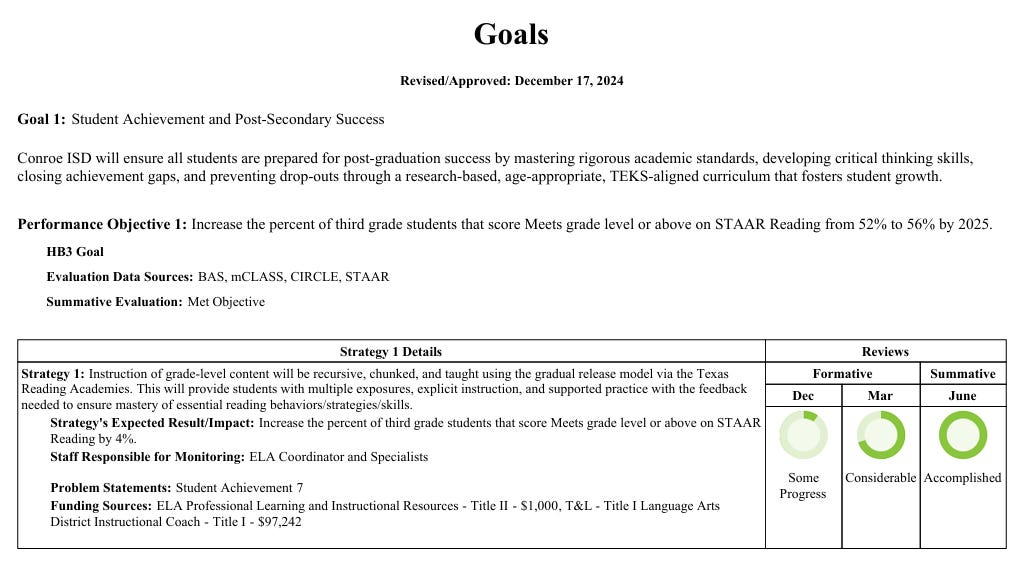
Here are that goal’s strategies:
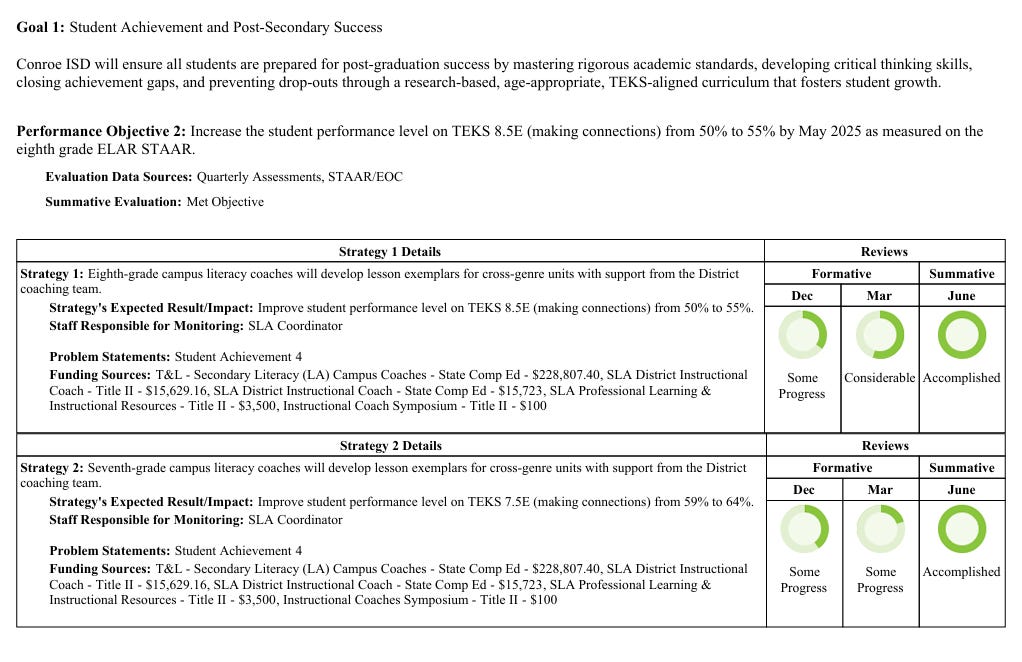
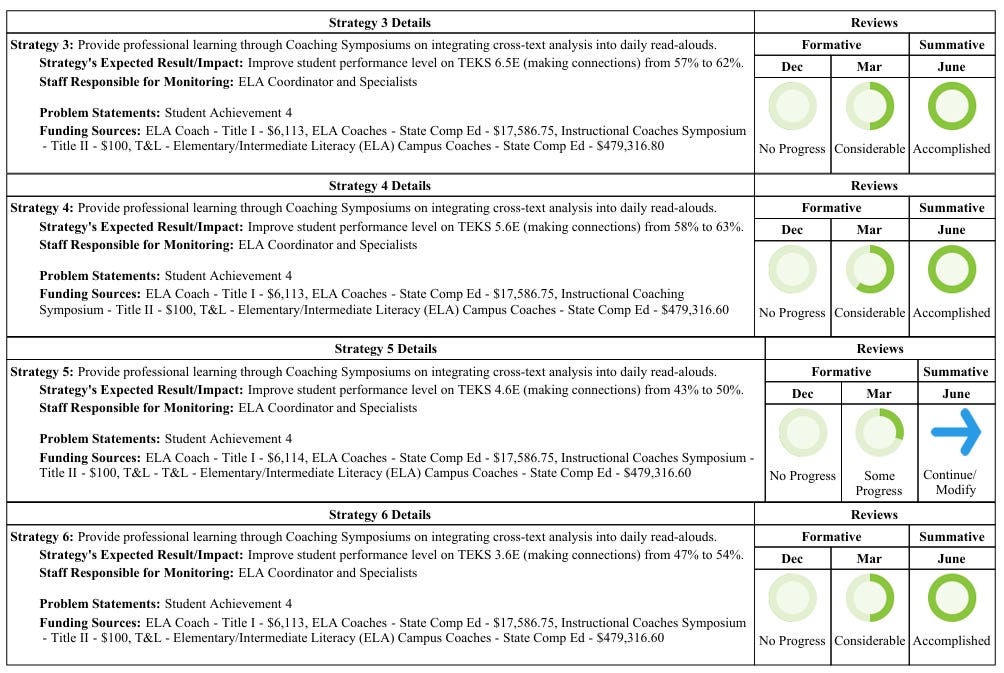
This is my main complaint with school boards today. As they spend hours on construction updates, curriculum debates, or creating policy based on political party platforms, they are completely ignoring the detailed level of planning that our district staff are working on every day.
Literally every single board meeting should have an update regarding progress towards the district meeting its goals to improve student outcomes, and they simply do not.
Their priorities are platitudes.
“Protect our kids”
Many school board campaigns run on slogans like, “We will fight for our kids”, “We will get bad books out of libraries”, or “We will rid indoctrination out of classrooms.” Okay…how?
Every time a campaign tells you they want to do something, I want you to ask them, “How?” Because this is where the rubber meets the road.
You want to protect children? Great! Are you going to overhaul the student discipline policy? Are you going to spend the hours it will take offline to review process and procedure with district staff to find a way to make sure children are safe at schools? Are you going to collaborate with the district attorney to make sure everything falls within the law?
You want to improve test scores? Awesome! Which ones? Are you going to look at introducing after-school tutoring programs or expand dual-language immersion that has proven results in other districts?
You want kids to have real-world skills when they graduate? Amazing! Are you going to deep dive the requirements for expanding CTE programs across high schools or enable high schoolers to earn more college credits before graduation?
You believe AI is the future and we need to prepare? Let’s go! Are you going to research and partner with support organizations to implement AI ethics & literacy initiatives? Are you going to prioritize creating policy and supporting both student’s and teacher’s needs regarding development of programs that train our students on AI concepts?
The list goes on and on, but it requires board trustees to actually do work and not waste hours of public meetings on meaningless changes that have little to no impact on student outcomes.
I’m done ranting; sorry about that.
Running for Board
With my previous board experience, volunteer efforts, extensive writing on the issues, and realization that our district’s focus is clearly not on a positive trajectory, I decided that I would give it a go to run for school board.
I created a website, went through the process to obtain an IRS EIN, submitted my Treasurer Appointment to the school district and had it returned with a stamp, opened a small business account with a local bank, setup my donation account, then posted my announcement on Facebook.4
Here are the hard truths for a campaign such as ours:
I am not part of any political party. In an era when being on a MOCO (Montgomery County) conservative voting guide is a make-or-break scenario for winning, it becomes difficult to imagine a scenario where we can win without a significant movement behind us by the time October gets here.
We will be going up against two slates of candidates, plus others that join in. As the Tea Party vs non-Tea Party MOCO “war” rages on, we will likely see the three “Mama Bear” candidates (backed by the Tea Party), the three “Protect CISD” candidates (backed by non-Tea Party Republicans), myself, and a few others I believe will join in. It’s going to be crowded.
We also will not have large political PAC dollars funding a consulting group to manage our campaign.
This means everything we do will be driven by local support.
Our Campaign
Within the first week of announcing our campaign we received $500 in donations, about 20 volunteers, and countless comments of support online. This may be small, but not bad for February.
I also met with other candidates, various supporters, and I spoke at the February Board Meeting during public comment.
We launched a Jira board and have built out an extensive project plan, and we are mapping out our content schedule for the months ahead.
Our campaign will focus on the following key items:
Student outcomes, improving teacher wellness and retention, rebuilding trust through transparent governance, and introducing modern technology strategies (i.e., AI) as opportunities for success.
We will not get into flame wars with people online, nor will we be pulled into the MOCO “war” raging in the local party.
Almost all of our content will be created to inform voters of how things work and where we see opportunities for improvement. Although I did air grievances in this post, all future activity will be geared towards education and spotlighting opportunities.
Future posts will also focus on how we are progressing through the campaign, and we will be sharing lessons learned along with next steps. Feedback is always welcome!
I welcome you to visit www.ryanforcisd.com for more info, or follow our socials:
Facebook: https://www.facebook.com/ryanforcisd/
Instagram: https://www.instagram.com/ryantforcisd/
Thanks for reading.
As referenced in the conservative Texas Scorecard, “The policy also prohibits instruction or materials described as “unpatriotic or anti-American.” District legal counsel Kara Belew noted during the meeting that the terms aren’t defined in state law and would be interpreted and applied by the superintendent.”
As with all things there is context and nuance to understand policy changes.
PMs are shaking their head right now.
I will be doing much more writing as we go through the process of campaigning, building materials for future campaigns that may need guidance on the topic. More to come on this.
Ryan, thank you for running for board of trustees!
You raised valid concerns about vague policy language, especially around phrases like ‘unpatriotic or anti American sentiments.’ I agree that the current wording is not ideal. At the same time, it seems impossible to write a rule that defines every ideological statement a teacher might make, because teaching is inherently contextual and people often do not recognize their own beliefs as ideological.
Even without explicit policy language, teachers have always been subject to scrutiny for how they present content. This includes situations where a teacher frames a historical event in a one sided way, expresses personal political opinions in class, or signals approval or disapproval of certain social movements. These situations have always required administrative judgment, documentation, and context. In that sense, the unwritten rule has always existed, and it is one of the things that makes the teaching profession so difficult to navigate for the people who are actually in the classroom.
Given that no policy can realistically script every scenario,
do you believe
this is an area that needs clearer language,
or is it one of those situations where professional judgment will always have to fill the gaps?
If you do think clearer language is needed, what would that look like in practice?
Or is this one of those scenarios that, in your view, does not need to be addressed through policy at all?
I love that you have a jira board for your campaign!