

TLDR: Someone is paying for a political push poll targeting Conroe ISD voters ahead of the November 2026 election. The script is framed as a survey, but it’s designed to sell you on the current board, not measure your opinion. This is the same playbook used to elect the current board in the first place, likely funded by the same network of out-of-district PACs and political consultants. We have the finance records to prove it, including suspiciously late amended finance reports. You deserve to know how it works, who’s behind it, and why they’re doing it now.
You Got a Text. It Wasn’t What It Looked Like.
If you’re a Conroe ISD voter, there’s a good chance you’ve received a text message in recent weeks asking you to participate in a “survey” about the November 2026 school board election.
It opens innocuously enough. Do you plan to vote? What do you think of Donald Trump? Ken Paxton? Ted Cruz? Standard stuff, the kind of questions any legitimate pollster might ask to understand the electorate.
Then it pivots:
“Over 40% of Conroe ISD 3rd grade students were not performing at grade level in math or reading. In response, the new board of trustees implemented High Quality Institutional Materials (HQIM). The Texas Education Commissioner recently stated that ‘Conroe has seen a massive turnaround in their scores.’ Does knowing this make you more likely or less likely to re-elect members of the current board?”
And then it keeps going. Same structure, five more times:
The current board removed “sexually illustrated materials” from classrooms. More or less likely to re-elect?
The current board protects parental rights and believes parents should be in the driver’s seat. More or less likely to re-elect?
The current board wants to restore traditional values and keep schools free from political agendas. More or less likely to re-elect?
The current board is fighting back against woke ideologies threatening our children’s future. More or less likely to re-elect?
The current board is focused on increasing funding for public education. More or less likely to re-elect?
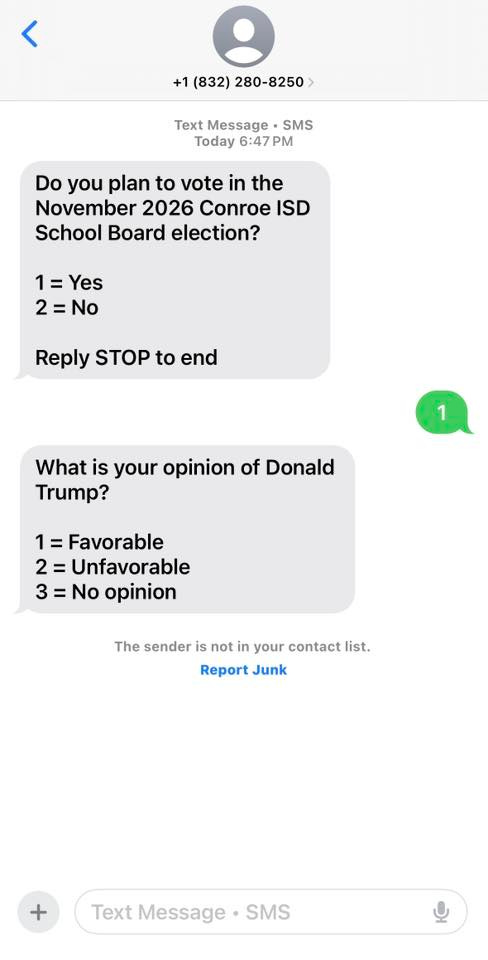
That’s not a poll. That’s a pitch. And there’s a specific name for this tactic.
What Is a Push Poll, and Why Does It Matter?
A push poll is a political tool disguised as a survey. The goal isn’t to measure what voters think. The goal is to change what voters think, by feeding them curated, one-sided talking points under the cover of a question.
The technique works because most people drop their guard when they think they’re being surveyed. You’re answering questions, not being sold something. By the time the call or text is over, the messages have been delivered, and the respondent often doesn’t realize they were targets of a persuasion campaign, not participants in legitimate research.
Here’s how you spot one: it asks “does knowing this make you more or less likely...” Legitimate polls ask what you already think. Push polls tell you something first, then ask how you feel about it. They present only one side, and they’re deployed in the months before an election, not after.
How Push Polls Actually Get Built and Deployed
What most people don’t realize is that running a push poll at scale is a professional operation with multiple layers of cost, and depending on how it’s funded, some of those costs may never appear in any public record.
Under the Texas Election Code, any money spent to influence a political campaign must be reported as a political expenditure with the Texas Ethics Commission. That includes polling and voter contact operations. If a candidate’s campaign directly pays a vendor to conduct a text-based push poll, that payment has to show up on a finance report with the vendor’s name, address, and the amount paid. Reports are filed on a set schedule: semiannually in January and July, and in the 30-day and 8-day windows before an election.
But here’s the gap: if the money flows through a privately funded PAC rather than a candidate’s campaign account, the disclosure requirements are different, and in some cases the true source of the funding never surfaces publicly at all. PACs funded by private donors with no public disclosure obligations can pay for voter contact operations, pass the results or services to a campaign as an in-kind contribution, and the candidate’s report only shows the in-kind value, not where the PAC got its money. This is the core of what critics mean when they use the term “dark money.” The spending shows up, but the original source doesn’t.
The mechanics of how these texts actually reach your phone are worth understanding, because every step in the process has a cost attached to it.
First, someone purchases a voter contact list from a data broker. These brokers aggregate personal information, including cell phone numbers, from sources ranging from public voter rolls to commercially harvested data: loyalty programs, app permissions, online forms, and dozens of other places where people have unknowingly shared their contact information. The list is then filtered by geography, party registration, voting history, and demographic profile to target likely voters in a specific race. That targeting is itself a paid service.
Next, the scripted message sequence is loaded into a campaign text blast platform, services like Hustle, Strive, or similar tools built specifically for political mass texting. These platforms charge per message sent, sometimes by the segment, sometimes by the contact, and can push thousands of texts in an hour.
Finally, a political consulting firm manages the whole operation: writing the script, managing the vendor relationships, analyzing the response data, and refining the targeting for future sends. Each layer, the data, the platform, the consulting, carries its own invoice. In the 2022 Conroe ISD races, finance records show payments to CAZ Consulting for line items explicitly described as “SMS Text Messaging,” “Online Advertising,” and “MMS,” and Texans for Educational Freedom separately provided a “Texting Service” valued at over $2,000 as an in-kind contribution directly to one candidate. That’s the same infrastructure, just documented.
What’s funding the 2026 operation may be structured to make sure it stays undocumented until it’s too late to matter.
Meet the Consultant: CAZ Consulting and Chris Zook Jr.
Christopher Zook Jr. is the president of CAZ Consulting, a political consulting firm he founded in December 2021, seven months after he founded Texans for Educational Freedom (TEF), a statewide PAC that has spent hundreds of thousands of dollars on school board elections across Texas. Before starting CAZ, Zook worked as political director for Congressman Wesley Hunt, as a fellow in Ted Cruz’s Washington office, and as a field director for the Harris County Republican Party.
According to Texas Ethics Commission filings reviewed by the Texas Observer, CAZ Consulting and its subsidiary Tripple Threat Strategies have done campaign work almost exclusively for Texans for Educational Freedom, which had paid them more than $200,000 for school board consulting work as of October 2024.
CAZ operates from two Houston-area addresses: 5436 Holly Springs Dr (Houston, TX 77056) and 6255 Willers Way (Houston, TX 77057). A related entity, C3 Management, operates from the same Willers Way address and appears in multiple CISD candidate finance reports billing for bookkeeping and accounting services.
This isn’t a local parents group. It’s a professional political operation with a documented track record of deploying its agendas into Texas school districts.

They’ve Already Done This Here
Texans for Educational Freedom didn’t discover Conroe ISD in 2026. The finance records show they were here in force in 2022.
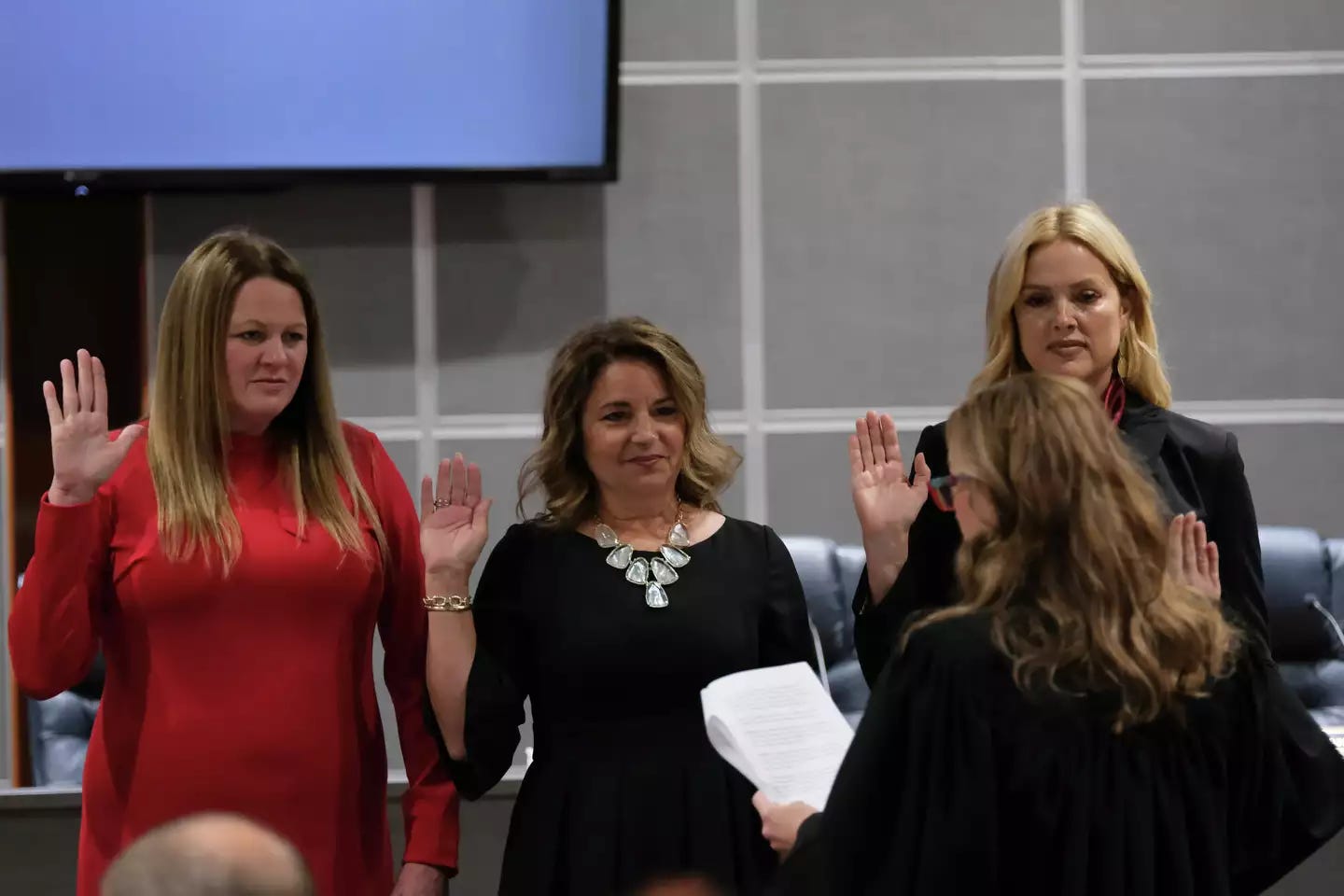
In November 2022, three candidates running as the “Mama Bear” slate, Melissa Dungan, Tiffany Nelson, and Misty Odenweller, won their elections and took seats on the Conroe ISD board. The candidates came together through a Facebook group called Mama Bears Rising, which according to reporting by The Nation (March 2024) was co-founded by Cassandra Crowe, who at the time and continues to work as a policy adviser to State Representative Steve Toth. Toth is well-known to support Mama Bear candidates, providing them resources and funding through donations, as well as access to his office for events such as this one:

Campaign finance records filed with the Texas Ethics Commission document exactly how the CAZ/TEF network was embedded in all three campaigns.
Misty Odenweller
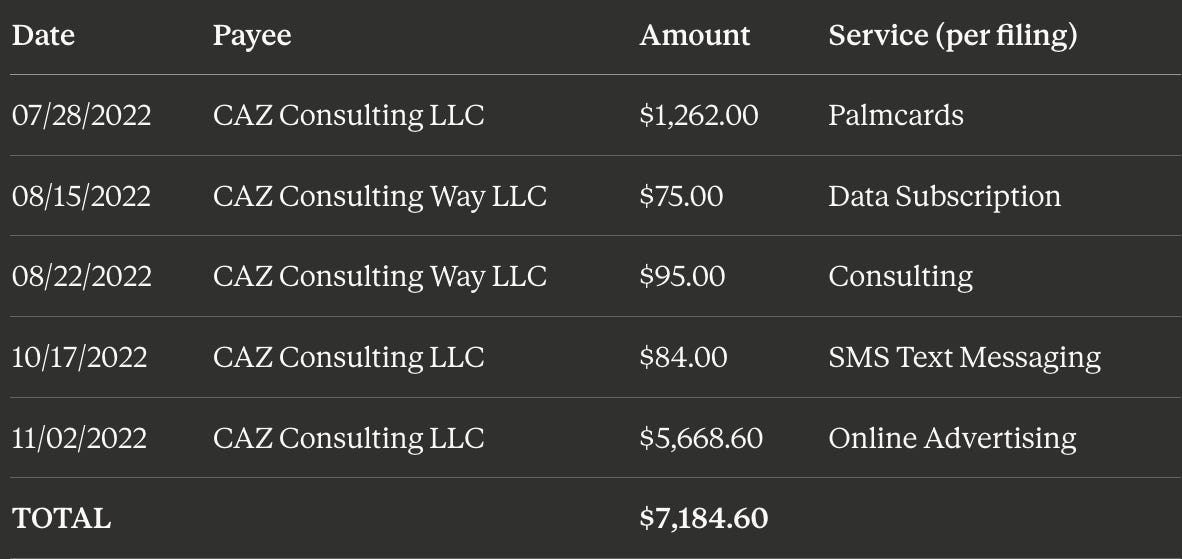
Odenweller’s post-election finance report covering July through December 2022 shows payments directly to CAZ Consulting LLC (6255 Willers Way, Houston TX 77057) and CAZ Consulting Way LLC (same address) for the following services as described in her own filings:
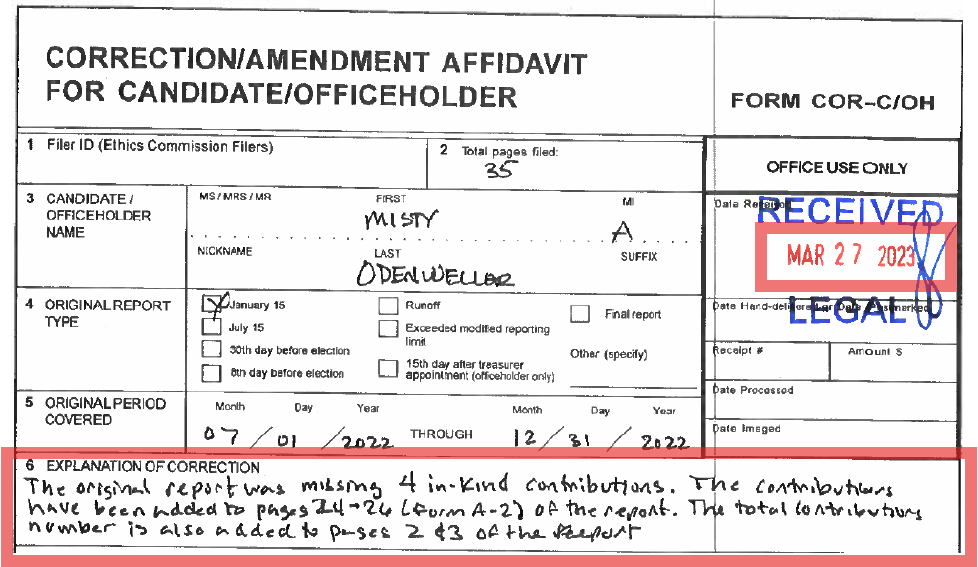
Odenweller's campaign amendment, filed March 27, 2023 (months after the required reporting period), also revealed multiple in-kind1 contributions from TEF that were missing from her original reports:
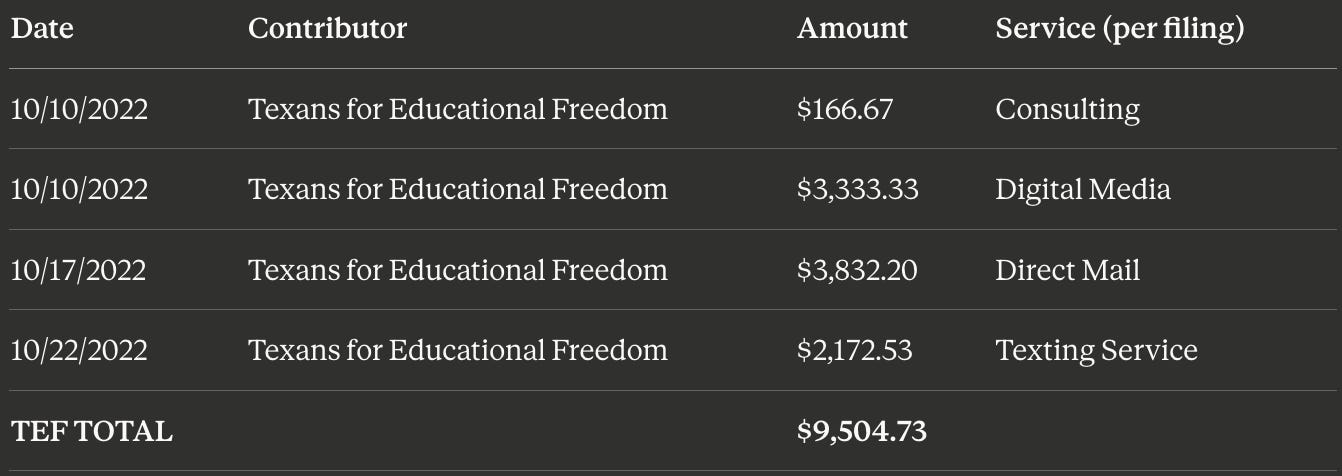
Total documented campaign services from CAZ/TEF for Odenweller: $16,689.33.
Separately, on October 10, 2022, Odenweller’s campaign also made a $10,000 donation directly to Texans for Educational Freedom, Zook’s own PAC. Her finance report categorizes it plainly: “Donations made by Candidate/Donation.” This is a distinct transaction from campaign services received. It represents money flowing out of her campaign and into the PAC, not services rendered to her campaign. It is, however, a significant data point: at the same time she was receiving TEF in-kind support, she was also funding the organization providing it. She was simultaneously a client and a funder of the same operation.
Melissa Dungan
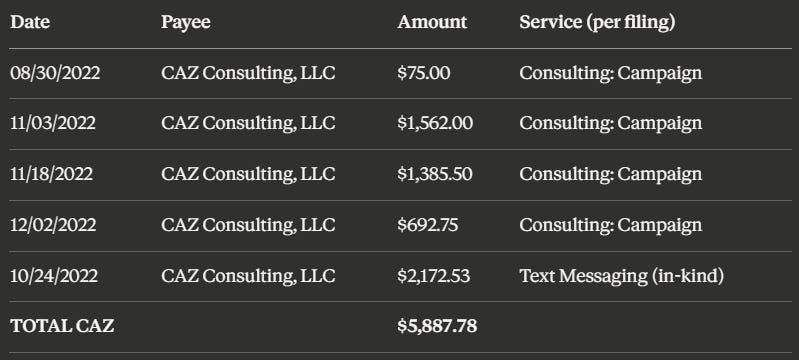
Dungan’s finance records show a different structure but the same network. Her 30-day pre-election report documents a $75 payment to CAZ Consulting, LLC (5436 Holly Springs Dr, Houston TX 77056) described as “Consulting Expense: Campaign.” Her post-election January 2023 report then shows three additional CAZ payments after election day:
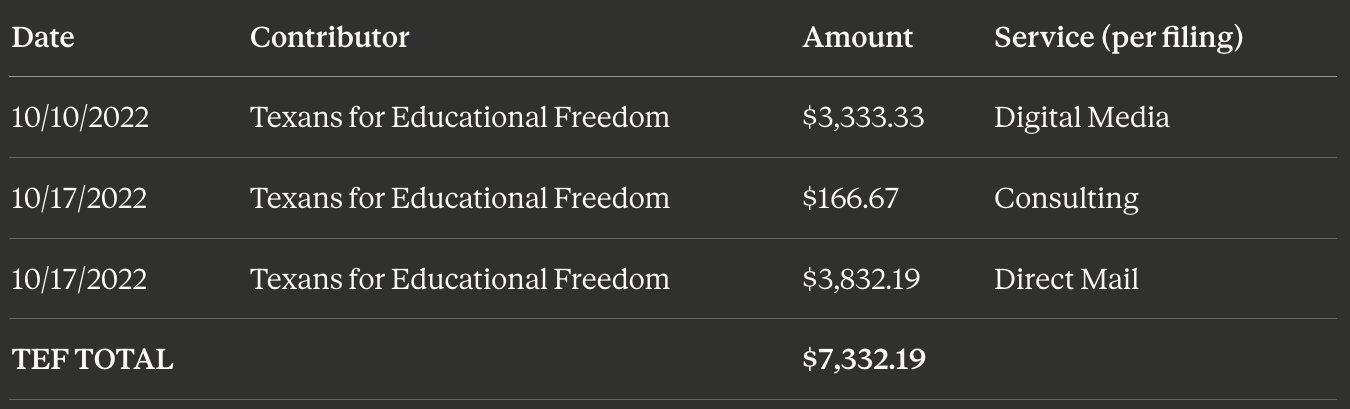
Her 8-day pre-election report and subsequent amendment show TEF in-kind contributions across three categories:
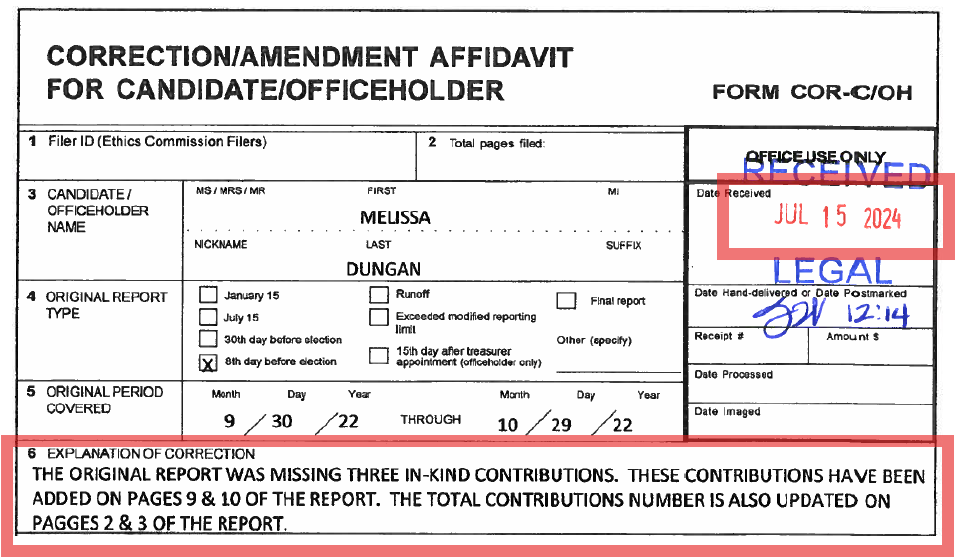
And the most important fact is her amended report was made over a year and a half after the election:
Total CAZ/TEF involvement in the Dungan campaign: $13,219.97
Tiffany Nelson
Nelson’s records show the most extensive TEF involvement of all three candidates. Across her 30-day report, her amended 8-day report, and her January 2023 post-election report, CAZ Consulting and C3 Management (same Willers Way address) appear repeatedly:
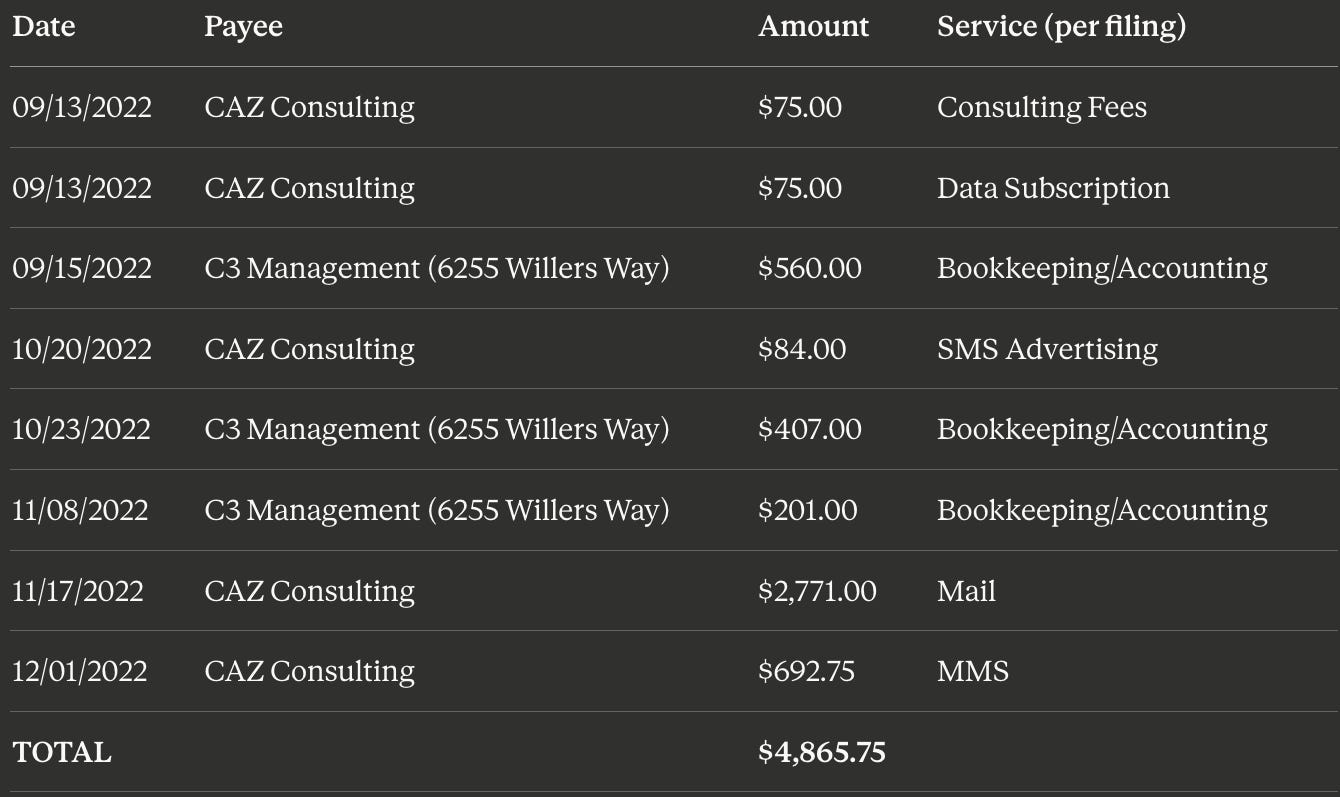
Then there’s what TEF poured in directly as in-kind contributions:
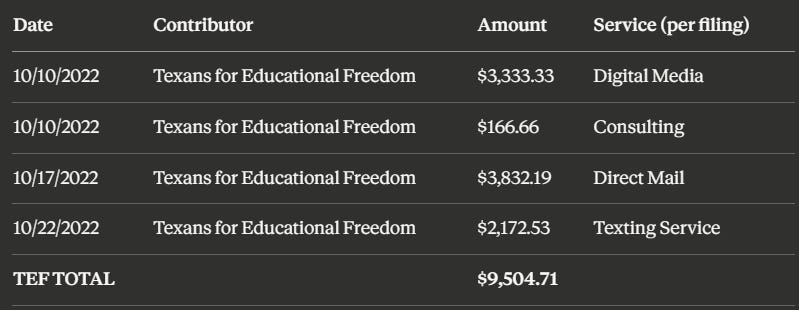
The texting service TEF provided Nelson in October 2022 is the same category of service now being used to deliver the 2026 push poll to Conroe ISD voters.
And similar to the others, Tiffany also filed her amendment months after the election:
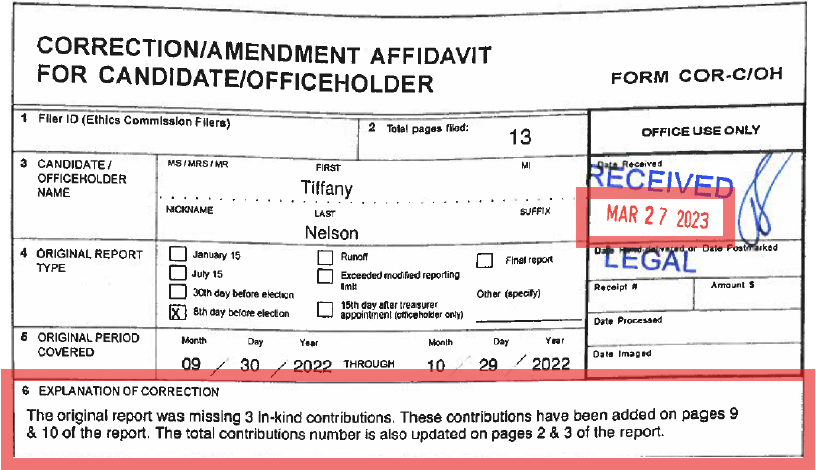
Total CAZ/C3/TEF involvement in the Nelson campaign: $14,370.46.
The Three-Candidate Tally
When you add it up across all three 2022 Mama Bear candidates:
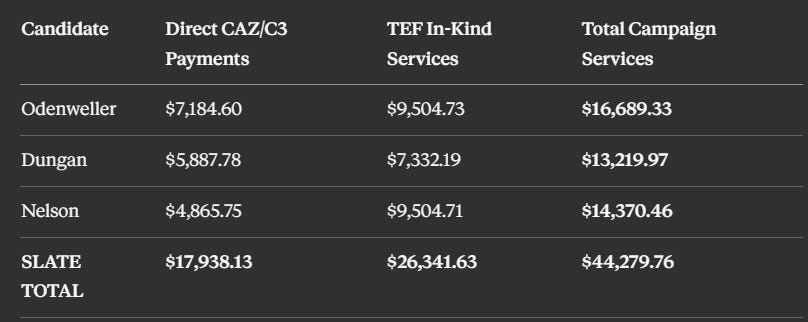
Over $44,000 in documented CAZ/TEF money flowed through the three 2022 Mama Bear campaigns, from a single consultant who founded the PAC in early 2021 and then launched his consulting firm seven months later to service it.
This is not a grassroots operation. It never was.
Why Now? Why Conroe ISD?
Here’s the part that explains the urgency behind the push poll hitting phones in April 2026.
In November 2025, Cy-Fair ISD held its school board election. Cy-Fair is the third-largest school district in Texas. In 2023, Texans for Educational Freedom helped elect a conservative slate there, giving the board a 6-1 “conservative” supermajority. Over the next two years, that board implemented aggressive book bans, Bible-based curriculum, cut 50 librarian positions as part of sweeping budget reductions, and restricted classroom discussions of gender identity, vaccines, and climate change.
On November 4, 2025, voters threw them out.
A slate of three pro-public education candidates, Lesley Guilmart, Kendra Camarena, and Cleveland Lane Jr., swept all three contested seats, flipping the board from a 6-1 “conservative” majority to a 4-3 majority in the other direction. Board president Scott Henry and vice president Natalie Blasingame both lost their seats. Despite endorsements from the Harris County Republican Party and a visit from Governor Greg Abbott days before the vote, all three “conservative” candidates lost.
The same reversal had played out in Clear Creek ISD, Fort Bend ISD, and Katy ISD, where conservative slates won seats on culture-war messaging and then lost them when communities saw what the board actually did once in power.
Conroe ISD, the 7th largest school district in Texas with approximately 73,000 students, is the last major district in the Houston area still under full “conservative” board control, and the only large district in Texas with an all-”conservative” board. For the network that built this majority, Conroe is the last domino they cannot afford to lose.
There’s another variable: Tiffany Nelson, one of the three original 2022 Mama Bears, resigned her CISD trustee seat early to run for the Texas State Board of Education, a race she recently won the Republican primary for. The board subsequently appointed Aggie Gambino to fill her vacated seat. That appointment, combined with the upcoming November 2026 election cycle, raises the stakes for both sides.
That’s why a push poll is running in early April, eight months before the election. They’re not measuring opinion. They’re trying to build a floor before organized opposition gets started.
The stakes of getting this wrong are not abstract for Zook. When the Texas Observer began its investigation into his network’s school board operations, he responded on X:
“Thank you for the great coverage. Just a week ago, parents successfully flipped Cy-Fair ISD, the third largest district in the state. Let’s keep focusing on improving student outcomes, empowering parents, and supporting our teachers.”
He was celebrating the 2023 conservative wins in Cy-Fair at the time. In the next election, that “conservative” majority lost seats and the board flipped. The celebration was premature. The lesson for Conroe is that majorities built this way don’t hold forever, and Zook’s network knows it.
What This Costs, and Who’s Paying For It
Push polls aren’t free. A text campaign reaching a meaningful slice of Conroe ISD’s voter base, which spans fast-growing Montgomery County precincts, costs real money: vendor fees, voter list acquisition, platform costs, and the consulting firm behind the execution.
Campaign finance records filed with the Texas Ethics Commission will eventually show who funded this. When pre-election reports drop in the 30-day and 8-day windows before November 2026, those records will either confirm or reframe what we already know.
In the meantime, the push poll script is documented. Potentially thousands of Conroe ISD residents received it. The messaging is identical to the rhetorical framework the current board has used in its public communications.
The infrastructure is the same. The playbook is the same.
What You Should Take Away From This
The push poll you received is asking how you feel about the current Conroe ISD board, but only after it tells you what to think about the current board. That’s the mechanism. It’s not subtle once you see it.
The network operating behind this has real resources, a real track record, and over $44,000 in documented spending just on the three 2022 CISD candidates. That number doesn’t include the 2024 slate: Nicole May, Lindsay Dawson, Melissa Semmler, and Marianne Horton, whose records tell their own story.
That apparatus is already running for 2026. The question is whether Conroe ISD voters know it’s happening.
Here’s what you can do with this information:
Know the difference between a poll and a push poll. If a “survey” is telling you things and asking how you feel about them, it’s not measuring your opinion. It’s trying to change it.
Ask who’s funding the candidates. Local school board races should be funded by local people. When over $44,000 from a statewide PAC and a single consulting firm shows up in three local school board races, that’s worth knowing.
Watch the money. Texas Ethics Commission filings are public record at ethics.state.tx.us. When pre-election reports drop before November, look at who’s paying whom.
The November 2026 Conroe ISD election is months away. The political operation working to hold this board is already on the clock. Now you know.
Thanks for reading.
The author is a candidate for Conroe ISD Board of Trustees in the November 2026 election.
Finance data sourced directly from Texas Ethics Commission campaign finance reports filed by Misty Odenweller, Melissa Dungan, and Tiffany Nelson (2022 to 2023). Additional sourcing: Texas Observer (March 2025, May 2024), Texas Tribune/ProPublica (April 2024), Houston Public Media (November 2025), The Nation (March 2024).
In-kind contributions are non-monetary donations of goods or services, such as direct mail, digital advertising, or texting campaigns, provided directly to a candidate's campaign and reported at their estimated dollar value.