


This happens all the time with elected boards, including HOAs, school districts, MUDs, or other special districts. A board director resigns while in the middle of serving their elected term, and the board must take action to replace them. The replacement process can include calling for a special election or simply appointing a new person to complete that trustee’s term until the next election. Nine times out of ten, boards will appoint a new person rather than go through the election process.
Many people do not understand that boards can appoint people to public office when resignations occur. They often assume voters must elect them, but Texas law allows for appointments in these scenarios. Even if there are elections, they can be cancelled if they are uncontested (no opposing candidates in the race), allowing the board to save the time and money it takes to have an election.
Sec. 11.060. VACANCIES
(a) If a vacancy occurs on the board of trustees of an independent school district, the remaining trustees may fill the vacancy by appointment until the next trustee election.
(b) If the board is appointed by the governing body of a municipality, a trustee appointed by the governing body to fill a vacancy shall serve for the unexpired term.
(c) Instead of filling a vacancy by appointment under Subsection (a) or (b), the board or municipal governing body may order a special election to fill the vacancy. A special election is conducted in the same manner as the district’s general election except as provided by the Election Code.
(d) If more than one year remains in the term of the position vacated, the vacancy shall be filled under this section not later than the 180th day after the date the vacancy occurs.
Most small boards rarely have volunteers to run for an election anyways, so appointing a new board director is often seen as the best solution. Why wait until the next available election window when you can just add someone now, making sure the seat is filled and you are able to meet quorum when needed?
Also, a board usually appoints someone they know and trust, making sure they are aligned with their goals and/or agenda. This helps keep board priorities in focus and moving forward, which can be positive or negative depending on who you ask.
However, this process can be used for questionable switcheroos, as our local school district has seen before:
“The Conroe ISD board of trustees appointed board President Skeeter Hubert to fill the position being vacated by Trustee Scott Moore, who submitted his resignation in August.
Moore serves as the trustee for Position 7, which is not up for election in November. While his resignation is not effective until Nov. 16, the resignation creates an immediate vacancy on the board.
Hubert, whose position is up for election this year, planned to run for re-election but was disqualified due to an error on his application. The district did not catch the error until after the filing deadline so Hubert was not permitted to submit a new application.”
This gave board President Hubert the ability to stay on the board for another two years without being elected.1 Critics were quick to point this out, even though no laws were broken, and understanding that appointments like these are quite common with many boards.
Here in our backyard with Conroe ISD, this changeover is about to occur. We’ll go on a short tangent about this change and then move back to the topic of appointments.
Tiffany Nelson has resigned as CISD Trustee
For anyone that follows our local school board you know that one of our school board trustees, Tiffany Nelson, launched a campaign to run for the State Board of Education (SBOE).
As Texas law does not allow for someone to hold both SBOE office and a school board trustee, Tiffany is required to resign. Although the timing for resignation is interesting. State law requires that candidates for SBOE must not currently hold public office:
Board members may not hold other public offices. This also applies to candidates seeking election to the board.
However, the Attorney General interpretation holds that a school board trustee must resign before the general election:
“In addition to the Texas Constitution, state law may affect whether a current school board trustee may run for a specific office while continuing to serve on the school board. For example, Texas Education Code section 7.103(a) provides that a person is not eligible for election to or service on the State Board of Education (SBOE) if the person holds another public office. According to the attorney general, this means that a school board member must resign from the school board prior to the date of the general election for a place on the SBOE. Tex. At’y Gen. Op. No. WW-0165 (1957).
Based on this, when Tiffany filed to run and when she resigned from the school board is not relevant, but it sent me down a rabbit hole for a good 20 minutes after I saw that she deleted an Instagram post regarding her filing:
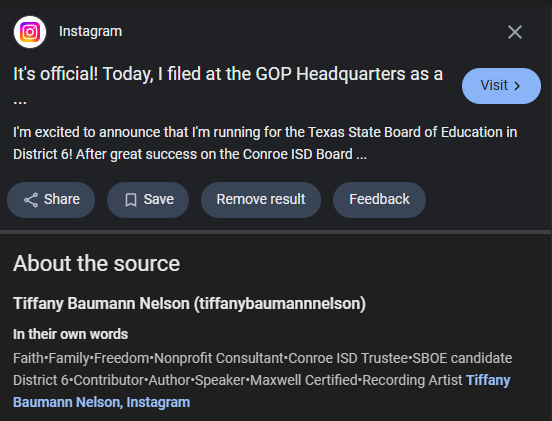

Official records do confirm her filing on Nov 20th:

Lastly for those curious, resigning from a board can be as simple as an email, and the school board can wait until the next public meeting (or beyond) to appoint a replacement.
Tiffany served less than one term on the school board, leaving one year early to pursue office with the SBOE. She has one opponent in the Republican Primary, Barbara Denson.
How will our school board fill the spot?
This is more speculation on my part, but for those who are plugged into local groups we know the board will likely appoint someone within the next few months. My bet is that Aggie Gambino is the obvious selection for appointment by the current school board.
Aggie originally launched her campaign for the CISD School Board back in 2024, running within the ‘Mama Bear’ slate of candidates. However, there ended up being five ‘conservative’ candidates for four positions, and someone had to bow out, which was Aggie.
I am (again) speculating, but my belief is that Tiffany was always planning to run for another office, and thus it was promised to Aggie that she would either run in the next election as part of the conservative slate of candidates, or that she would be appointed when the time came.
This gives support to the reasoning why the school board has pushed to pass so many ideological policy and curriculum changes so quickly, as Tiffany needed the “wins” as part of her platform to run for SBOE. This included her personally securing $6,000 (from a private source) of the $7,500 in funds spent for 10 Commandment posters for all of Conroe ISD, which was somehow pushed through the district without board approval in a public meeting. This decision included the decision to put the posters on the walls, which are now being taken down.2
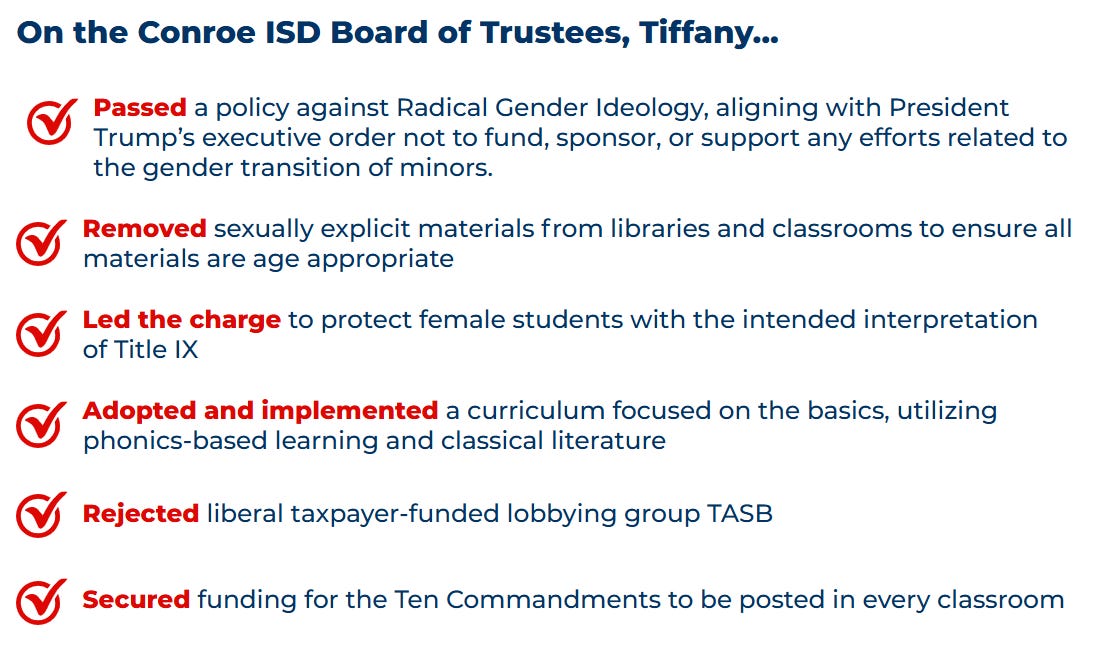
Getting back to Aggie, her campaign website is still up, and her donation page is available.
Aggie does have some recent accomplishments, primarily helping to create a new non-profit, the Conroe ISD Special Education Parent Advisory Board (SEPAC). This non-profit is external to the school district, as compared to the Texas required parent-led Student Advisory Health Council (SHAC).3
I commend the work these types of groups do and believe they are vital for student success, especially for students with special needs. Although, there are reasons to be concerned.
Through a few contacts I learned there was a bit of drama with the SEPAC non-profit, as they were attempting to use internal school district staff to promote the group and also book conference rooms (for free) at the school district’s conference center to hold meetings, similar to the district’s SHAC. Other non-profit groups learned about this and filed complaints, and that quickly killed the initiative behind the SEPAC as they could not afford to book nice meeting locations for large groups.
There are other interesting things about Aggie we could review for another post, including that her family successfully sued Conroe ISD regarding a dispute with her child’s special education, although based on the results of Aggie’s case they did not get hardly any of the relief they requested. It was arguably a weak case based on the results, as compared to another well-known case against Conroe ISD by the Fusca family (note Mark Fusca is also an executive member on the SEPAC).
For the SEPAC, I do hope they will work more to inform parents with getting the resources they need, rather than guiding them towards how to take legal action.
I have met and spoken with Aggie a few times in person, and overall, my impression is that she is passionate, actively involved within the school district, a capable driver for initiatives, and that she is a good advocate for areas such as special education. My hope is that this advocacy will include all students and families within the district, along with the 10,000 District staff and teachers who will rely on her support.
Why Appointments Matter
The interesting thing about appointed board directors is that they usually win their election after appointment, whether it is in a contested or cancelled election. For smaller boards like HOAs or MUDs, uncontested elections are usually the norm, so they may stay on another term without any challenge.
School boards are almost always contested, and being an incumbent has a huge advantage over challengers, as the incumbent can tout whatever policies they supported during their short term, and they get plenty of face time with the community via public meetings or other activities related to being a board director.
What can the public do about appointments they do not like?
Nothing, other than voting against them in the next election.
At most, there is law that requires a board to appoint someone within 180 days if there is a year left within the previous board trustee’s term, which could be remedied by public complaint. But this does not work the other way around.
This is why whom you vote for in an election to a school board matters more than just the individual person. It is the decisions that they will make and the potential for them to decide on appointing others to the same board when openings are available, which happens often.
How should a board approach appointments?
This is a subjective question that depends on the needs of the board and the district it represents. As said already, a board typically wants to appoint directors that are aligned with the board’s existing goals or agenda. This includes people they know, which can be problematic for finding those without bias. But appointing a member by simple vote is the simple, fast solution. This is important if you have issues of meeting quorum.
There are boards that ask the public for volunteers, having candidates submit a form to “apply” for the open board position. This gives the board a way to vet candidates and review internally before discussing during an open meeting. This can give the board a broader reach into the community to find people with previous board experience rather than simply appointing a ‘friend-of-a-friend’ that was interested, or an existing board member who could not run for re-election.
In my opinion, the process of appointments should have more rulemaking put in place, including public notice that a board member has resigned, a call for volunteers, and that candidates be given 5-10 minutes at a public meeting to present their qualifications and platform. This allows the public to see which candidates the board is able to select from, and the board’s decision can be more visible rather than them simply deciding behind the scenes or during executive session.
More transparency is important for public confidence and support of new board members.
In the end, however, it is a decision of the board itself, and they can basically appoint whomever they want into an open position.
Thanks for reading.
Do you have a topic that you would like to see covered related to Texas school districts, HOAs, MUDs, or other small government entities? Contact me at ryant@wehavequorum.net and let me know!
Skeeter did not run for re-election, instead running for the Texas House, but he lost in the Republican Primary.
The 10 Commandments posting in Conroe ISD may need its own post, as it is not clear to me how one board trustee can approve spending public dollars without a public vote in an open meeting.
Solid analysis of an underexamined governance issue. The point about incumbency advantage after appointment is critcal, most voters dont realize that by the time the next election happens, the appointed trustee has already built name recognition and can claim board accomplishments. The lack of structured transparency around appointments (no mandatory application process, no public candidate presentations) creates openings for cronyism that undermines democratic accountability. Boards should atleast be required to publicly solicit applications and hold candidate forums before voting.
Please do a deep dive on the posters. On the surface, this seems like a TOMA violation.