


UPDATE for this article:
As of June 2026, the Board tabled these Board Operating Procedures indefinitely. They will not be implemented for now. Please read what these procedures would have changed below.
On May 12, 2026, the Conroe ISD Board of Trustees adopted its first ever Board Operating Procedures Manual on a 4-3 vote. Trustees Horton, Semmler, and Dungan voted against it. Note that Trustee Dungan is Vice President of the Board.
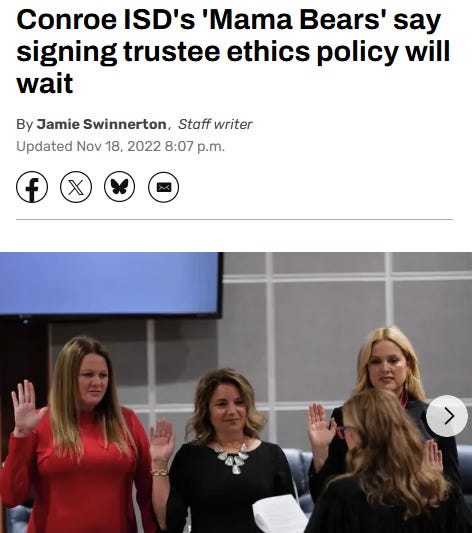
The adopting of these new procedures is a meaningful moment regardless of how you feel about the outcome. The CISD board has never had a comprehensive operating procedures document before. For years, the closest thing was a TASB-modeled Code of Conduct that trustees were asked to sign individually. Several current trustees, including members of the Mama Bear slate, refused to sign that Code of Conduct on the grounds that it came from the Texas Association of School Boards (TASB). The Mama Bears have been distancing the school district away from TASB services by contracting with Texans for Excellence in Education (TEE). I covered TEE in a separate article, which explains why.1
The creation of a board operating procedures manual is, in itself, a step forward. It defines important processes and a new code of conduct, as examples. However, it also concentrates significant authority in the Board President, which we will break down here.
This article is detailed on purpose. If you’re short on time, skip to the TLDR at the bottom.
What are Board Operating Procedures?
Board Operating Procedures are the internal rules a board sets for itself. They are different from Board Policy, which governs the district. Operating Procedures govern how the trustees do their work, how meetings are run, how agendas are built, how complaints are handled, how communication flows, and how officers are elected. They are the rules of the road for the seven trustees on the board.
A well-written set of operating procedures should generally accomplish three things:
Create consistency and predictability: Trustees, staff, and the public should be able to rely on the board following a consistent process. Meetings should run the same way every time. Agenda items should be submitted and processed through a defined path. Decisions should follow a clear sequence from proposal to vote.
Define roles and authority clearly: A board operates as a collective body, not as a collection of individuals. Operating procedures should specify what the board does as a whole, what individual trustees can and cannot do on their own, and what falls within the superintendent’s domain. Clear role definition prevents confusion and keeps the board focused on governance rather than operations.
Establish accountability mechanisms: Procedures should include structures that hold the board itself to a standard. That includes training requirements, transparency in how decisions are made, and a defined process for handling concerns. Accountability mechanisms are not just for the district. They apply to the governing body as well.
The board’s new Operating Procedures succeeds at several of these goals, but its accountability mechanisms raise questions about how evenly authority is distributed across the board.
Follow along in the document as we go through the important items:

Which Changes are Good
It is worth being clear about what is good in this manual, because there are improvements that are important.
A documented code of conduct
The Code of Conduct section (pages 7-8) is comprehensive. It includes commitments to equity, trustworthiness, honor, integrity, service, achieving trustee goals, maintaining appropriate roles, transparency, and professionalism. It explicitly requires trustees to disclose conflicts of interest, to recuse from votes where they cannot be impartial, and to refrain from using their position for personal advantage. These are not new ideas but having them written down and formally adopted matters.
As a comparison, the previous Code of Ethics that CISD board trustees signed is comparable but has significant differences.
The new Code of Conduct appears to be built on the same framework as the TASB Code of Ethics it replaced, using nearly identical structure and language throughout. The differences are in what was removed:
TASB’s Code of Ethics explicitly protects individual trustee judgment against pressure from any individual or group. Mama Bears dropped that clause entirely.
TASB asks trustees to encourage different opinions. Mama Bears asks only that they listen.
TASB calls for working toward consensus. Mama Bears substitutes alignment and adds a non-disparagement requirement.
Basically, the new document that replaced the TASB code looks a great deal like the TASB code, with the trustee-protecting language taken out.
Clear separation of board and superintendent roles
The new procedures repeatedly emphasizes that individual trustees do not direct staff, do not investigate district matters on their own, and exercise authority only as a body acting at a properly posted meeting. Page 2 states it plainly: “A Trustee has authority to exercise power or bind the Board or Conroe ISD only when acting as a member of the Board of Trustees at a properly posted meeting at which a quorum is present.” That language reflects existing Texas law (Texas Education Code §11.151 and the Texas Open Meetings Act) but seeing it in a board’s own document is meaningful.
Training requirements and tracking
The Trustee Training section (page 15) requires the superintendent to maintain an annual mandated training list and individual trustee attendance log. This is good practice. Texas requires specific trustee training, and tracking compliance publicly creates accountability.
Agenda transparency
The document establishes a formal Agenda Item Request Form process (page 21), requires 10 business days advance notice for non-emergency items, and requires the superintendent to circulate trustee questions and answers about agenda items to all trustees before the meeting. These are good procedural improvements.
Policy development process
The Trustee Policy Development section (page 17) creates a structured process for proposing, drafting, and adopting Board Policy changes, including two readings at separate meetings, a 90-day general timeline, and a formal request form. This is healthy governance.
Communication discipline
Several provisions correctly remind trustees that text messages, emails, and other communications about district business are subject to the Texas Public Information Act, that deliberation outside of a posted meeting violates the Texas Open Meetings Act, and that confidential information must remain confidential. Again, these are existing legal requirements, but documenting them creates a teaching artifact for future boards.
Censure section removed
In an earlier draft of the document, there was a section regarding trustee censure2 procedures. During the March 2, 2026 special meeting, trustees discussed and ultimately struck the entire Trustee Sanctions/Censure section out of concern that it could be used “punitively or to suppress dissent” and out of concern for First Amendment implications. General Counsel also noted that removal from the board is governed by state law, not by the board itself. Removing this section was a good decision. It reflects an awareness that operating procedures can be weaponized against dissenting trustees, and the board chose not to give itself that tool.
That last point is worth holding onto, because the same logic applies to provisions that did remain in the document.
Where the Document Concentrates Authority in the Board President
A board president serves as a facilitator and a meeting chair. Under Texas law, the president has limited unique authority. Most powers a board president holds come from the board itself, through bylaws or operating procedures. The new Board Operating Procedures grants the President substantial powers across multiple domains. Individually, several of these provisions may be defensible. Collectively, they create a single point of control over what other trustees can do, attend, say, and bring forward.
Here is what the new operating procedures gives the Board President.
Approval of all trustee reimbursements:
The Officer Duties section (page 12) lists as Power #5 that the President “Approves all Trustee reimbursements subject to the Trustee Event Reporting Form.” The Trustee Event Reporting section (page 16) further specifies that “Activities involving more than de minimis costs must be approved in advance by the Board President in order to be eligible for reimbursement.” Reimbursements submitted by the Board President are approved by the Vice President.
What this means in practice: if another trustee wants to attend a training, a conference, or a relevant statewide meeting that costs more than mileage to a nearby location, the Board President can decline to approve it. The trustee may still attend but cannot be reimbursed. For trustees who serve without compensation and may not have the personal budget to cover lodging and registration, that is a real financial barrier.
Each trustee is independently elected to represent the same constituents. This document gives one of those trustee’s financial authority over the others' access to professional development.
Trustee training and professional development are not optional extras. Texas law requires school board trustees to complete specific training hours, and attendance at conferences and statewide meetings is how trustees stay current on legislative changes, district finance, curriculum standards, and governance best practices. A trustee who cannot attend those events is a less informed trustee. Less informed trustees ask fewer questions, catch fewer problems, and are less equipped to hold the superintendent accountable. The constituents who elected them bear the cost of that gap.
Officer eligibility tied to training compliance, as announced by the President yearly:
The Officer Elections section (page 13) requires the President to announce each trustee’s training compliance status at the October Board meeting. Any trustee whose training hours are “deficient” as of that announcement is not eligible to be nominated or elected as an officer. The provision exempts newly elected or appointed trustees but not sitting ones.
This is where the structure gets concerning. The President controls reimbursement for training (provision 1 above). The President then announces who is training-compliant. Training compliance is the gate to officer eligibility. The mechanism for tracking is described as a log maintained by the superintendent, but the announcement, and the political weight of that announcement, sits with the President.
Whether this gets abused depends entirely on whether the President plays it straight. Good governance does not depend on the goodwill of individuals. It depends on structures that work even when individuals do not.
To add to this note, we must recognize that the Mama Bears board is hostile towards TASB and favors TEE for training and conferences, as we’ve seen as the current board president recently attended and gave a presentation at a TEE-sponsored event.

I should note my response to the Board President in that post…
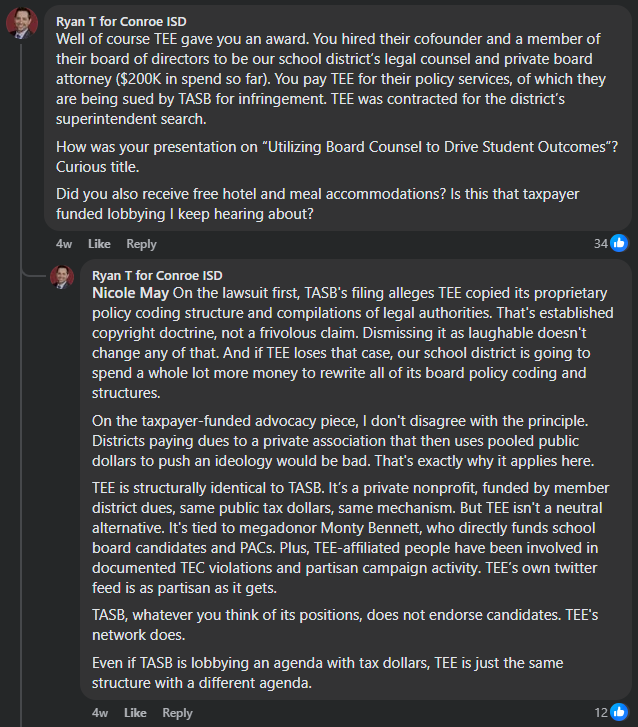
Does this mean that TASB conferences will not be approved, even though they are the most relevant and informational for Texas board trustees?
Approval of the preliminary agenda:
Page 21 states: “Before the official Agenda is posted for any meeting, the Superintendent shall consult the Board President to ensure that the preliminary Agenda and the topics included are approved by the Board President.” The provision adds that the President “shall ensure that any topics timely submitted through the Conroe ISD Board of Trustees’ Agenda Item Request Form are either on that Agenda or scheduled for deliberation at an appropriate time in the near future, usually within two regular Board meetings.”
Translation: an item submitted by another trustee through the formal Agenda Item Request Form can be deferred up to two regular board meetings (approximately two months) at the President’s discretion. The trustee who submitted it has no procedural recourse during that window. Compare that to many other boards where any trustee can place an item on a future agenda without officer approval. The board now requires the President’s approval at the front end of every agenda.
This is the single most consequential provision in the document. The agenda is the floor. A trustee cannot make a motion, propose a policy, or bring district business to a vote unless the item is on the agenda. The Texas Open Meetings Act requires it. So whoever controls the agenda controls what gets discussed.
Sole authorized spokesperson and approver of all board communications:
Page 22 designates the Board President as “the authorized spokesperson for the Conroe ISD Board of Trustees” and requires that “all Trustees will refrain from speaking for the Conroe ISD Board of Trustees or Conroe ISD and will explain they are speaking in their individual capacity as a Trustee, as appropriate.” It also states: “The Superintendent will ensure that the President approves any Conroe ISD Board of Trustees communication before it is distributed.”
Designating a single spokesperson is normal and reasonable. The board should speak with one voice on official board positions. What is less normal is requiring the superintendent to ensure the President approves any board communication before distribution. That gives the President editorial veto over what the board, as a body, says to the public.
The document does also note that trustees retain free speech rights at public functions in their individual capacity (page 22). That is correct as a matter of First Amendment law and would apply regardless. The question is what the board says collectively, and whether one trustee should hold the pen.
Routing of complaints about trustees:
Page 24 states: “The Superintendent shall refer all substantive complaints from staff and/or third parties regarding a Trustee to the Board President for review and action. If the complaint is about the Board President, the Superintendent shall refer the complaint to the Vice-President.”
Read that carefully. Complaints from staff or community members about any trustee, other than the President, go to the President “for review and action.” There is no definition of “action,” no required process, no requirement to inform the trustee who is the subject of the complaint, and no requirement to share the complaint with the rest of the board.
The censure section was struck in March because trustees recognized that internal disciplinary mechanisms could be used to suppress dissent. This provision recreates a softer version of the same risk. Complaints can be substantive or can be politically motivated. Without a defined process for what happens after a complaint is received, “review and action” sits with the President alone.
Officer terms locked between elections:
Page 13 states: “Unless there is an extraordinary circumstance, such as a death or resignation, the Conroe ISD Board of Trustees’ Officers will not be changed between terms.” Officers serve two-year terms and may succeed themselves.
There is no described mechanism for the board majority to remove an officer who is failing to perform the duties of the office, abusing the powers above, or losing the confidence of fellow trustees. Texas law does not require a removal mechanism, but most well-functioning boards have one. The Mama Bears chose not to include one.
What the 4-3 Vote Tells Us
The vote on May 12, 2026 was 4-3 to approve these new Board Operating Procedures. Trustees Horton, Semmler, and Dungan voted no. Dungan is the Board Vice President. Let that sit for a moment.
The second-highest officer on the board, the trustee who would step into the President role under the procedures the board was adopting, voted against adopting them.
At the meeting, Trustee Horton raised concerns about provisions expanding the Board President’s authority, said she was unaware those changes had been incorporated, and stated she had submitted her concerns the Sunday before the meeting, within the 30-day window for review. Legal counsel confirmed the document had not substantively changed in 30 days, only typographical and formatting edits. Other trustees noted the board had spent approximately 209 days and seven hours of dedicated meeting time on the document. Horton attempted to make an amendment to the motion. A motion to call the vote was made and seconded before her amendment could be fully considered, which procedurally ended debate.
Both of these things can be true at the same time.
Yes, the board spent significant time on these Board Operating Procedures. The February 2, 2026 workshop included over three and a half hours in closed session on board governance. The March 2, 2026 special meeting included a multi-hour open session review of the draft, during which trustees agreed to substantial changes, including the removal of the entire censure section. There were workshops and discussions in between. The 209-day, seven-hour figure is plausible.
Yes, Horton’s concerns may have come late in the process, and the rules require items to be submitted in advance. That is a real point, although we would have to request all of the board’s email correspondence to confirm when items were submitted over the last few months.
Regardless, even after 209 days, the board could not produce a document that achieved alignment. Three trustees, including the Vice President, voted against it. That is not a minor split. It is not a single dissenter. It is nearly half the board.
In the March 2 meeting, one trustee moved to take the operating procedures discussion out of closed session. The motion failed for lack of a second, though the board did eventually return to open session “out of an abundance of caution.” That detail tells us alignment problems existed throughout, not just at the end.
When a governance document fails to unite the body it governs, that is itself a signal. It does not mean the document is wrong, but it does mean the process did not produce consensus. A 4-3 vote on the rules that the board will operate under for the foreseeable future is a fragile foundation.
Why This Matters for Voters
In November 2026, three Conroe ISD trustee seats will be on the ballot. The trustees elected this fall will inherit this document. They will operate under its rules. They will be subject to whatever Board President is in place when they take office.
A new trustee who wants to bring a policy proposal forward will go through an Agenda Item Request Form approved by the President. A new trustee who wants to attend training or a relevant conference will need the President to approve reimbursement. A new trustee who runs for officer will need the President to announce they are training compliant. A complaint filed against a new trustee, by anyone, will be routed to the President “for review and action.”
None of these provisions will necessarily produce harm. They may be administered fairly. They may turn out to be fine. The point is that they sit in the document as written, and the question of whether they cause harm depends on the judgment and good faith of one elected trustee at a time. That is not a governance structure. That is a personality test.
This is not a partisan question. It is a governance question. It applies regardless of who holds the President role and what their politics are. A board that gives its President too much authority creates the same risks whether the President is a Mama Bear or not.
The right standard is simple: write the rules for the worst-case version of every officer, not the best-case version of the one currently in the chair.
TLDR
On May 12, 2026, the CISD Board adopted its first ever Board Operating Procedures Manual on a 4-3 vote. Trustees Horton, Semmler, and Dungan voted no. Dungan is the Board Vice President.
This is CISD’s first formal board operating procedures document. Previously, only a TASB-modeled Code of Conduct existed, which several current trustees refused to sign due to their protest of TASB.
These procedures do several things well: code of conduct, training tracking, agenda transparency, policy development process, communication discipline, and the removal of a censure section that could have been used punitively.
These changes also concentrate substantial authority in the Board President, including approval of trustee reimbursements, training-compliance announcements that gate officer eligibility, approval of the preliminary agenda, sole spokesperson authority including editorial approval of board communications, routing of complaints about trustees, and locked officer terms with no removal mechanism.
The board spent approximately 209 days and seven hours on this document. The fact that it still passed only 4-3, with the Vice President voting against, signals alignment problems that the lengthy process did not resolve.
Voters in November 2026 should expect candidates to speak to this document. Concentration of authority in one elected trustee creates risks regardless of who holds the office.
Thanks for reading. If you found this useful, please share it. Public information about how our school district governs itself belongs in public hands.
They believe TASB uses taxpayer dollars, through its school district membership, to lobby in favor of liberal issues such as LGBTQ+ rights. This claim is untrue.
Censure is a formal, public statement of severe criticism or condemnation. It is primarily used as a disciplinary measure in legislative, professional, or academic settings to officially rebuke inappropriate behavior or misconduct without removing the individual from their position.
Thanks Ryan for providing the info
I very much disapprove that under that new way that board members are increasingly restricted from investigating issues on their own. That's stupid. The whole point of voting to have a board by election is representation. If people can't or won't be represented and failure to be able to investigate issues results in failure to adequately represent - then we should not have a board at all. Modern methods of communication allow parents to represent themselves by reviewing and voting on issues. I'd much prefer that to what I see going on.